


TL;DR:
- Proper commercial outlet maintenance involves regular inspections, testing, and repair to prevent hazards and ensure compliance. It must be performed by qualified electricians with proper tools and documented procedures, especially under NFPA 70B standards. Using advanced techniques like thermography helps detect issues early and reduces long-term failure risks.
Commercial outlet maintenance is the practice of regularly inspecting, testing, and repairing electrical receptacles in a business setting to prevent hazards and keep operations running. Knowing how to maintain commercial outlets protects your property, your employees, and your compliance standing under NFPA 70B and OSHA regulations. NFPA 70B transitioned from a recommended practice to a mandatory standard, meaning documented maintenance programs are now required. Skipping routine outlet care invites fire risk, equipment failure, and costly regulatory penalties.
How to maintain commercial outlets: tools and prerequisites
Before touching any outlet, you need the right tools and a clear understanding of what you are and are not qualified to do. Property managers can handle visual checks, but wiring and code compliance inspections must be performed by qualified electricians.
Essential tools for outlet maintenance:
- Insulated screwdrivers (rated for at least 1,000 volts)
- Non-contact voltage tester to confirm power is off before any hands-on work
- GFCI outlet tester for quick functional checks
- Electrical contact cleaner for removing oxidation from receptacle faces
- Flashlight or headlamp for inspecting recessed or poorly lit outlets
- Personal protective equipment: safety glasses, insulated gloves, and rubber-soled footwear
Prerequisites before you start:
- Confirm the circuit is de-energized using a non-contact voltage tester
- Review your facility’s Electrical Maintenance Program (EMP), which must document scope, personnel qualifications, and procedures per NFPA 70B requirements
- Assign tasks only to personnel with documented training. Verbal competency does not meet the standard.
Pro Tip: Never rely on a breaker label alone to confirm a circuit is off. Always verify with a voltage tester at the outlet itself before proceeding.
For a broader look at what these maintenance tasks involve, Shepherdelectricalconstruction’s electrical services overview covers the full scope of commercial and residential work.
What does a proper outlet inspection look like?
A structured inspection process is the backbone of commercial property upkeep. Monthly visual inspections and GFCI testing are the baseline tasks every facility team should perform without exception.
Step-by-step monthly outlet inspection:
- Walk the space systematically. Inspect every outlet in the facility, moving room by room. Do not skip storage areas, break rooms, or utility spaces.
- Check for physical damage. Look for cracked faceplates, discoloration (yellowing or scorch marks), and loose outlet bodies that move when touched.
- Test every GFCI outlet. Press the TEST button. The outlet should lose power. Press RESET. Power should return. A GFCI that fails either step needs immediate attention.
- Use a GFCI outlet tester. Plug it into standard receptacles to confirm correct wiring polarity and grounding. A wiring fault light means the outlet needs professional evaluation.
- Check for heat or unusual odor. A warm outlet faceplate or burning smell signals a wiring problem. Remove the load and flag the outlet for professional inspection.
- Document every finding. Log the date, outlet location, test result, and any corrective action taken. This documentation satisfies NFPA 70B audit requirements.
| Inspection task | Frequency | Who performs it |
|---|---|---|
| Visual check for damage | Monthly | Property manager or trained staff |
| GFCI TEST/RESET button check | Monthly | Property manager or trained staff |
| GFCI outlet tester check | Monthly | Property manager or trained staff |
| Voltage and wiring verification | Quarterly | Licensed electrician |
| Infrared thermography scan | Quarterly to semi-annually | Licensed electrician |
Pro Tip: Keep a simple digital log, even a shared spreadsheet, with outlet ID numbers tied to a floor plan. Auditors and insurers respond well to organized records, and it takes less than five minutes per inspection round to maintain.
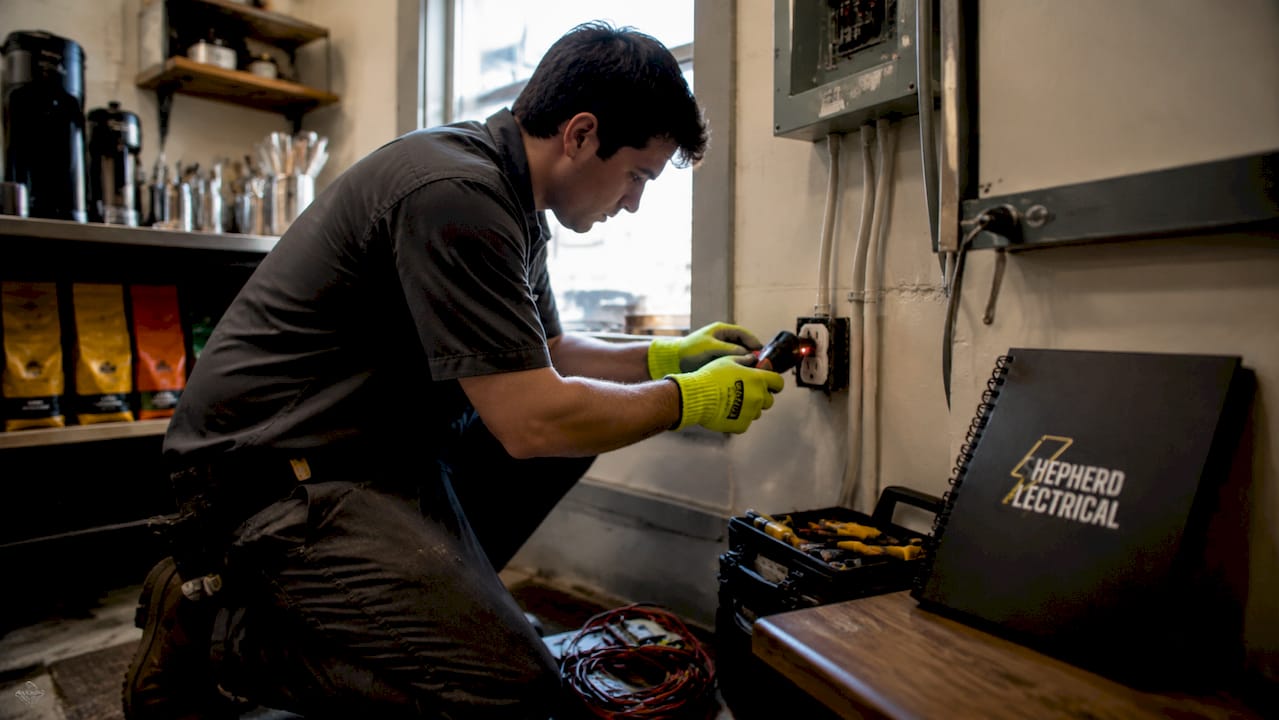
Shepherdelectricalconstruction’s guide on testing outlets for safety walks through the hands-on steps in more detail for managers who want a deeper reference.
What are the most common outlet problems in commercial spaces?
Recognizing a failing outlet early is one of the best practices for outlet care in any retail or office setting. The symptoms below each point to a specific root cause, and knowing the difference saves time and prevents dangerous guesswork.
- GFCI won’t reset: The most common cause is a persistent ground fault on the circuit. This means something downstream is still leaking current. Unplug all devices on that circuit before attempting a reset. If it still won’t reset, the outlet or wiring needs professional evaluation. Shepherdelectricalconstruction’s page on why a GFCI won’t reset explains the specific causes in plain terms.
- Hot outlet faceplate: Heat at the faceplate almost always means loose wiring, overloaded circuits, or a failing receptacle. Remove the load immediately and do not use the outlet until a licensed electrician inspects it.
- Flickering power at an outlet: Loose connections at the outlet’s terminal screws or at the panel are the typical culprits. This is not a DIY fix.
- Repeated breaker tripping: Root cause analysis is required before replacing any equipment. Tripping usually signals excessive load or degraded wiring, not a simple equipment fault.
- Discoloration or scorch marks: These are signs of arcing. The outlet must be replaced and the wiring inspected before the circuit is used again.
“Ignoring NFPA 70E recommendations invites OSHA citations. OSHA 1910 Subpart S mandates GFCI protection for receptacles in wet and damp locations, and violations carry serious financial penalties. Compliance is not optional for commercial operators.”
Visual checks are within reach for most property managers. Any repair beyond removing a load and flagging an outlet requires a qualified electrician. Unsafe DIY wiring work in a commercial space creates liability that no cost savings can justify.
What advanced techniques reduce outlet failures long-term?
Condition-based maintenance outperforms calendar-only schedules for managing store maintenance costs and reducing unplanned downtime. Risk-based maintenance strategies allow more precise resource allocation than fixed-interval servicing, which means you spend money where the actual risk is highest.
Infrared thermography is the most effective advanced tool available. Quarterly thermography scans by licensed electricians detect hot spots at outlet connections before they become fires. A thermal camera shows temperature differences invisible to the naked eye, catching loose connections and overloaded circuits early.
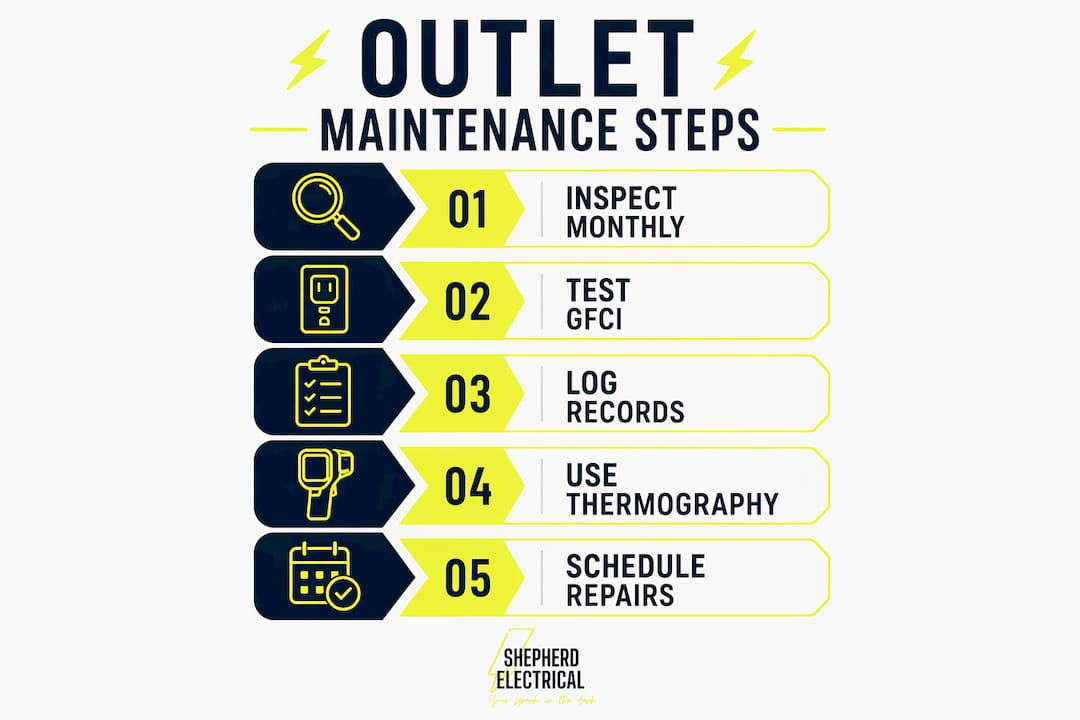
| Maintenance approach | Trigger | Best for |
|---|---|---|
| Calendar-based | Fixed schedule (monthly, quarterly) | Low-risk, low-load outlets |
| Condition-based | Diagnostic data or observed symptoms | High-use or aging circuits |
| Predictive (thermography) | Thermal anomaly detected | Critical circuits, wet locations |
A complete Electrical Maintenance Program ties these approaches together. It defines which outlets get which level of scrutiny, who performs each task, and how findings are documented. Without that structure, even good intentions produce inconsistent results.
Pro Tip: Ask your electrician to flag outlets in wet or high-traffic areas for quarterly thermography priority. Those locations carry the highest failure risk and the steepest OSHA penalties if they fail.
For more on how wiring condition affects outlet performance, Shepherdelectricalconstruction’s commercial wiring guide covers the connection between wiring health and outlet reliability. A solid property maintenance guide for landlords and managers also reinforces why electrical upkeep belongs in every annual maintenance budget.
Key Takeaways
Effective commercial outlet maintenance combines monthly visual inspections, GFCI testing, documented records, and qualified electrician involvement for anything beyond surface-level checks.
| Point | Details |
|---|---|
| Monthly inspections are mandatory | Check every outlet visually and test all GFCI devices each month without exception. |
| Documentation satisfies NFPA 70B | Log every inspection date, result, and corrective action to meet audit and insurance requirements. |
| Qualified personnel handle repairs | Property managers inspect; licensed electricians repair, test wiring, and perform thermography. |
| Infrared thermography prevents fires | Quarterly scans detect overheating connections before they cause damage or downtime. |
| Condition-based scheduling saves money | Prioritize high-risk outlets with diagnostic data rather than treating every circuit identically. |
What I’ve learned after years of commercial outlet calls
The most common mistake I see from property managers is treating outlet maintenance as a reactive task. Something fails, someone calls, we fix it. That cycle is expensive and avoidable. The managers who run the tightest, safest facilities are the ones who treat their outlet inspection log the same way they treat their lease renewals: scheduled, documented, and non-negotiable.
The second mistake is underestimating what NFPA 70B now requires. This is no longer a guideline you can loosely follow. It is a mandatory standard with documentation requirements that insurers and inspectors will ask to see. A verbal “we check things regularly” does not satisfy an audit.
The third thing I’d push back on is the idea that advanced tools like infrared thermography are only for large facilities. A small retail space with aging wiring and high outlet load is exactly the environment where a thermal scan pays for itself. One prevented outlet fire covers years of inspection costs.
Partner with a qualified electrical contractor for anything beyond visual checks. The liability exposure from DIY wiring work in a commercial space is not worth the short-term savings.
— Brad
Shepherdelectricalconstruction’s commercial electrical services
Shepherdelectricalconstruction serves commercial property managers and small business owners across Edmond and the Oklahoma City Metro with outlet inspections, GFCI testing and repair, and full electrical maintenance support.
The team handles everything from GFCI outlet repair to panel upgrades, with every job documented to meet NFPA 70B and OSHA standards. You can see examples of completed commercial work in the Shepherdelectricalconstruction projects gallery. Booking an inspection or repair is straightforward. Call or text (405) 406-1026, or schedule online through the Jobber booking link on the website.
FAQ
How often should commercial outlets be inspected?
Monthly visual inspections and GFCI testing are the baseline requirement for commercial facilities. Licensed electricians should perform deeper electrical checks and thermography scans quarterly to semi-annually depending on the facility’s risk level.
What does NFPA 70B require for outlet maintenance?
NFPA 70B now mandates a documented Electrical Maintenance Program that covers scope, qualified personnel, maintenance procedures, and corrective action records. Verbal or informal maintenance practices do not satisfy the standard.
Can a property manager test GFCI outlets without an electrician?
Yes. Pressing the TEST and RESET buttons on a GFCI outlet and using a plug-in GFCI tester are tasks any trained property manager can perform. Wiring inspection, repair, and code compliance verification require a licensed electrician.
What causes a commercial outlet to run hot?
A hot outlet faceplate typically signals loose wiring connections, an overloaded circuit, or a failing receptacle. Remove all loads from the outlet immediately and have a licensed electrician inspect it before it is used again.
What is infrared thermography used for in outlet maintenance?
Infrared thermography detects heat anomalies at outlet connections that are invisible to the naked eye. Quarterly scans by a licensed electrician identify overloaded or loose connections before they cause fires or equipment failures.
Recommended
- Commercial Electrical Maintenance Guide for Property Managers
- Commercial wiring: safety and energy efficiency guide
- How to test electrical outlets for safety and efficiency
Need help with this at your home?
Shepherd Electrical helps Edmond and OKC metro homeowners with troubleshooting, repairs, GFCIs, outlets, and safety inspections. Free estimates are available, and workmanship is backed by a lifetime guarantee.