

Yes, a damaged weatherhead commonly causes a single-home outage, and the repair is almost always the homeowner’s responsibility before the utility will reconnect service. After a storm knocks out power to your house while your neighbors’ lights stay on, the weatherhead is often the reason. Understanding the role of weatherhead damage in outages helps you act faster, stay safe, and avoid the frustrating wait that comes from not knowing who does what.
Here is the ownership split utilities follow:
- Utility-owned: the pole, transformer, and service drop wire up to the point it connects at your weatherhead
- Homeowner-owned: the weatherhead, service mast/riser, meter base, service entrance cable, and main panel
- Key rule: utilities will not reconnect customer-owned damaged equipment until a licensed electrician repairs it and, in many jurisdictions, a local inspector approves the work
After a storm, many homeowners are surprised to learn the power company won’t flip their service back on until the homeowner’s side of the equipment passes inspection. That wait is not a utility delay — it is a code and safety requirement that protects you and the crew.
A single ice storm in Shelby County produced nearly 2,000 individual home outages traced directly to weatherhead damage, with repair costs ranging from a few hundred to several thousand dollars depending on the extent of the damage.
Key Takeaways
Weatherhead damage is a leading cause of single-home outages after storms, and utilities will not reconnect service until a licensed electrician repairs the homeowner-owned equipment and a local inspector approves the work.
| Point | Details |
|---|---|
| Homeowner owns the weatherhead | The weatherhead, mast, meter base, and service entrance cable are your responsibility, not the utility’s. |
| Utilities wait for inspection clearance | Repairs must be inspected and approved before the utility is permitted to reconnect service. |
| Stay clear of all equipment | The service drop stays live until the utility disconnects at the pole, regardless of your main breaker position. |
| Document everything for insurance | Time-stamped photos, the utility outage number, and the inspection receipt are the core documents for a claim. |
| Shepherdelectricalconstruction handles the full repair | Serving Edmond and OKC, Shepherdelectricalconstruction manages weatherhead repair, permits, and utility coordination. |
Table of Contents
- Who owns what: the utility vs. the homeowner
- How weatherhead damage actually stops your power
- Immediate safety steps if you suspect weatherhead damage
- Repair process: hiring an electrician, permits, and why utilities wait
- Typical timeline and what causes delays
- What repairing or replacing a weatherhead typically costs
- Insurance claims, documentation, and proving storm damage
- Why your neighbor still has power when yours is out
- What a licensed electrician will inspect and repair
- Local electrician perspective: what Shepherd Electrical sees after Oklahoma storms
- Shepherd Electrical handles weatherhead repairs in Edmond and OKC
- Sources
- FAQ
Who owns what: the utility vs. the homeowner
The “what’s ours / what’s yours” rule is the single most important concept to understand after storm damage. National Grid’s customer responsibility guide lists the weatherhead, service entrance cable, meter box, and main service panel as homeowner responsibilities for overhead service. Tampa Electric states the same: customers own the weatherhead, riser, and meter box, while the utility maintains the service line up to the home connection point.
Homeowner-owned components:
- Weatherhead (the curved pipe at the top of the service mast)
- Service mast and riser conduit
- Service entrance cable (from weatherhead down to meter)
- Meter base and enclosure
- Main service panel and grounding system
Utility-owned components:
- Pole and transformer
- Service drop wires (from transformer to weatherhead attachment point)
- Meter itself (the glass-enclosed device inside your meter base)
Jurisdictional details vary. Some utilities own the meter base; others do not. When in doubt, call your utility and ask specifically which components they maintain.
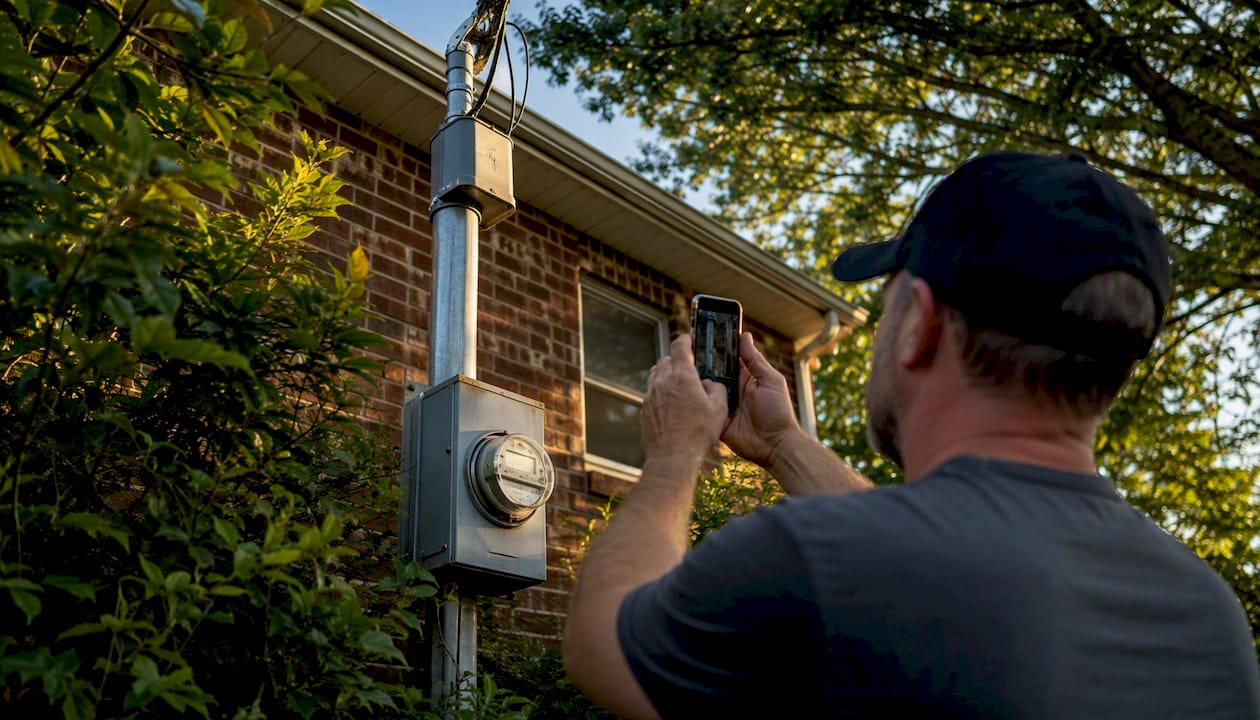
Pro Tip: Before any storm season, photograph your meter base, weatherhead, and riser from the ground. That baseline photo is worth its weight in gold when filing an insurance claim after damage.
How weatherhead damage actually stops your power
The electrical path from the street to your panel runs in one direction: service pole → service drop wires → weatherhead → riser/service entrance cable → meter base → main panel. Break any link in that chain and the house goes dark.
Here are the specific failure modes that cut power:
- Physical severance. A falling tree limb or ice load snaps the service entrance cable or shears the mast entirely. No physical connection, no power.
- Water intrusion. Weatherheads are designed to redirect moisture, but gasket cracks or impact damage let water enter, creating shock and arcing hazards inside the conduit.
- Arcing at a loose connection. A bent mast or pulled fitting loosens the connection between the service drop and the entrance cable. Arcing can melt insulation and trip protective devices.
- Bent mast pulling wires free. High winds or a ladder strike can bend the mast enough to pull the service drop attachment loose at the weatherhead, breaking the circuit.
- Meter base damage. A hard impact can crack the meter base enclosure, exposing live connections and triggering the utility to pull the meter for safety.
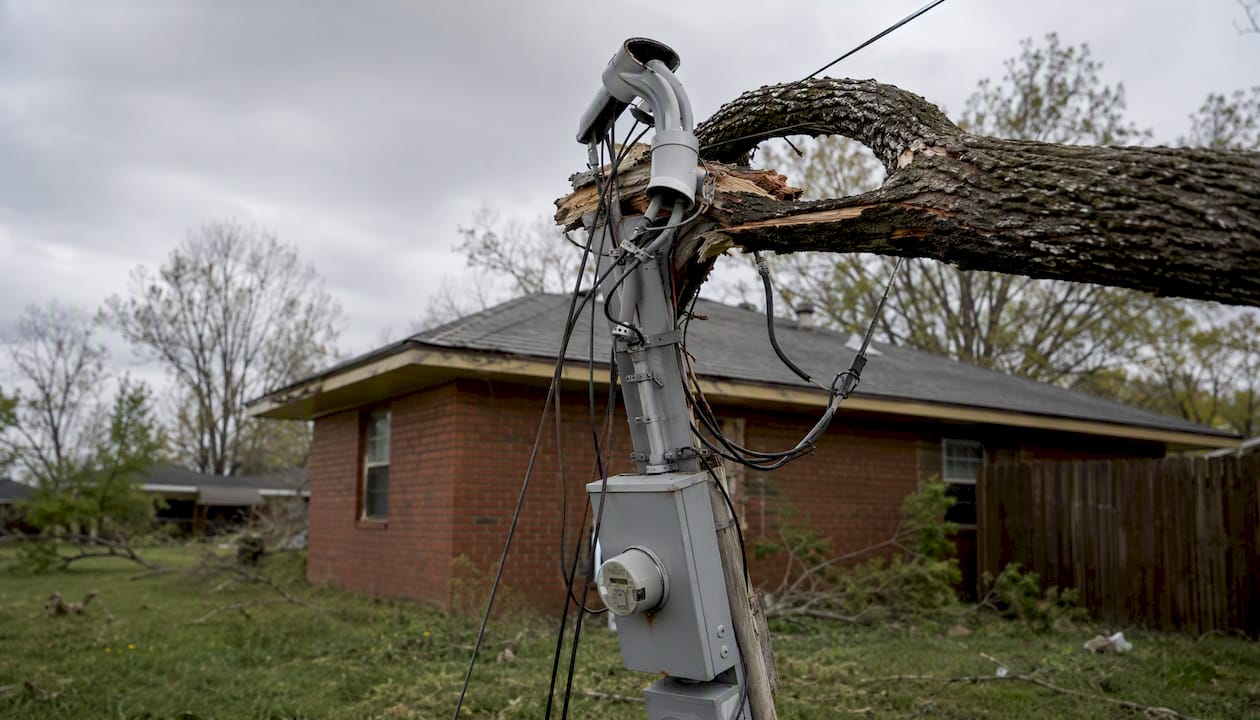
A fallen oak branch is the most common culprit in the OKC area. Ice accumulation on service drop wires is a close second, especially in January and February. A contractor’s ladder leaning against the mast during roofing work is a less obvious but surprisingly frequent cause of bent-mast damage.
FirstEnergy’s first-responder training warns that even weatherheads that look intact can carry hidden gasket failures. Keep hose streams away from the underside of the weatherhead — water under pressure can force its way through a crack that is invisible to the eye.
Pro Tip: If you see scorch marks, melted plastic, or a visible gap where the service drop meets the weatherhead, do not assume the main breaker makes it safe. Parts of the weatherhead remain energized regardless of breaker position.
Immediate safety steps if you suspect weatherhead damage
The most dangerous mistake homeowners make is assuming the main breaker cuts all risk. It does not. The service drop and the top of the weatherhead stay live until the utility disconnects at the pole.
- Stay back. Keep people and pets at least 30 feet from any downed wires or a visibly damaged mast.
- Do not touch the weatherhead, service mast, meter base, or any wire that has pulled loose.
- Do not spray water near the weatherhead or meter base — fine gasket cracks create hidden shock paths.
- Turn off the main breaker only if you can reach the panel safely from inside the house and there are no downed lines contacting the exterior.
- Call your utility first to report downed lines and suspected damage. In Oklahoma, OG&E customers call 405-272-9741; PSO customers call 1-888-218-3919.
- Then call a licensed electrician. Experts consistently warn that homeowners should never attempt weatherhead repairs themselves — the components can remain energized even with the main breaker off.
Safe visual checks you can do from the ground:
- Is the mast visibly bent or snapped?
- Are service drop wires sagging to the ground or touching the roof?
- Is the meter base cracked or hanging open?
- Do your neighbors have power? (If yes, the problem is almost certainly on your side of the meter.)
For a broader residential troubleshooting checklist you can safely run before calling, that resource walks through breaker checks and partial-power scenarios step by step.
Repair process: hiring an electrician, permits, and why utilities wait
The repair workflow follows a specific sequence. Skipping steps adds days to your outage.
- Report the damage to your utility and get an outage/incident number.
- The utility disconnects at the pole if downed lines are involved (they will not always do this proactively — ask).
- Hire a licensed electrician to assess and repair the weatherhead, mast, meter base, and service entrance cable as needed.
- The electrician pulls a permit if required by your local jurisdiction (most Oklahoma municipalities require one for service entrance work).
- A local inspector approves the repair.
- The utility reconnects service only after the inspection clearance is confirmed.
Utilities require that inspection clearance for a straightforward reason: they are legally and operationally prohibited from energizing customer-owned equipment that has not been certified safe. It is not bureaucratic delay — it is the rule that keeps their crews from working on a live, compromised system.
Pro Tip: Ask your electrician to call the utility’s contractor line while on site and provide the inspection documentation directly. That single step can cut reconnection time from days to hours.
Common permit requirements vary by city. Edmond, OKC, and most surrounding municipalities require a permit for service entrance replacement. Your electrician handles the pull; you just need to know it is part of the process and budget for it.
- Confirm the electrician is licensed in Oklahoma
- Ask for the permit number before work begins
- Request before-and-after photos of the repair
- Keep the inspection receipt to present to the utility
Typical timeline and what causes delays
Minor weatherhead repairs — a cracked cap, a loose fitting — can sometimes be completed the same day a licensed electrician is available. A full mast replacement with meter base work typically runs one to two days for the repair itself, plus permit and inspection time.
Common delay causes:
- Inspector backlog after major storms (inspectors serve multiple contractors simultaneously)
- Parts shortages for specific mast sizes or meter base configurations
- Tree or roof damage that must be cleared before the electrician can safely access the mast
- Utility priority queues: crews address downed distribution lines before individual service reconnections
- Contractor scheduling during high-demand storm periods
Steps that reduce your wait:
- Call your electrician and utility simultaneously, not sequentially.
- Clear debris from around the meter and mast before the electrician arrives.
- Ask your electrician upfront about permit timing and whether they can expedite inspection scheduling.
- Have your utility outage number ready — it speeds every call.
A local utility blog notes that homeowners who have a preferred electrician and an action plan before storm season finish repairs and permit work significantly faster than those who start searching after the damage occurs.
What repairing or replacing a weatherhead typically costs
Repair costs vary considerably based on what is damaged. A weatherhead cap replacement on an accessible single-story home runs toward the low end. A full mast replacement with meter base repair on a two-story home with roof damage sits at the high end.
Cost variables that move the number:
- Height and roof access (single-story vs. two-story, steep pitch)
- Scope: cap only vs. full mast and riser replacement
- Meter base condition (replacement adds parts and labor)
- Permit and inspection fees (typically $50–$150 in most Oklahoma municipalities, though fees are set locally and vary)
- Parts availability after widespread storm events
- Whether siding, fascia, or roofing must be repaired to restore the mast attachment point
Estimate checklist — have this ready when calling contractors:
- Time-stamped photos of the damage from multiple angles
- Whether the meter base is cracked or the meter was pulled
- Approximate height of the weatherhead from grade
- Presence of trees, overhangs, or other access obstacles
- Your utility outage/incident number
Pro Tip: Get at least two written estimates. After a major storm, a small number of contractors inflate prices knowing homeowners are desperate. A licensed local electrician with a track record in your area is your best protection against that.
Insurance often covers weatherhead damage caused by storms or falling objects under the dwelling coverage portion of a standard homeowner’s policy. Call your insurer before authorizing repairs to confirm coverage and ask whether they require a specific inspection or permit document.
Insurance claims, documentation, and proving storm damage
Document everything before any cleanup begins. Insurers need evidence that the damage was storm-related, not pre-existing neglect.
Documentation checklist:
- Time-stamped photos and video of the damage, taken from multiple angles
- Utility outage report number (get this when you call to report the outage)
- Written contractor estimates with itemized scope of work
- Permit number and inspection clearance receipt
- Any emergency board-up or debris-removal receipts
Most standard homeowner’s policies cover sudden, accidental damage from storms, falling trees, and wind. Gradual deterioration or pre-existing corrosion is typically excluded. Notify your insurer promptly — many policies have a reporting window, and late notification can complicate a claim.
Pro Tip: Ask your insurer whether they require a specific form of contractor documentation or a licensed inspector’s report before they release payment. Getting that answer before the repair saves a second trip.
Why your neighbor still has power when yours is out
Your neighbor’s power and yours run on separate service drops. The distribution line on the street feeds multiple homes, but each home has its own individual service drop connecting from that line to its weatherhead. A failure at your weatherhead, mast, or service entrance cable isolates only your home.
Safe diagnostic checklist:
- Check your main breaker panel — is the main breaker tripped?
- Ask two or three neighbors whether they have power
- Look at your meter from the ground — is it still seated, or has it been pulled?
- Visually inspect the mast from ground level for obvious bending or severance
- If neighbors are also out: the problem is likely on the utility’s distribution circuit. Call the utility to report.
- If neighbors have power and your meter is seated: the problem is almost certainly on your side of the meter. Call a licensed electrician.
- If the meter has been pulled: the utility has already flagged your service as unsafe. Call the utility for status and a licensed electrician for repairs.
Avoid touching any equipment regardless of what the visual check shows. Reporting the outage to the utility is always the right first call, even when the problem appears to be on your side.
What a licensed electrician will inspect and repair
When a licensed electrician replaces a weatherhead, the job covers more than swapping the cap. Here is what a thorough inspection and repair includes:
| Inspection Item | What the Electrician Checks |
|---|---|
| Utility disconnect confirmation | Verifies the utility has de-energized the service drop before work begins |
| Weatherhead and gasket | Replaces the weatherhead assembly and installs a new weatherhead gasket |
| Service mast and riser | Inspects for bending, corrosion, or physical damage; replaces if compromised |
| Service entrance cable | Checks insulation for arcing, melting, or abrasion damage along the full run |
| Meter base | Inspects enclosure integrity, jaw contacts, and grounding connections |
| Ground electrode system | Verifies ground rod continuity and bonding connections at the panel |
| Permit and inspection documentation | Pulls permit, schedules inspection, and provides clearance receipt for utility |
Visible signs a pro looks for:
| Sign | What It Indicates |
|---|---|
| Scorch marks or discoloration | Prior arcing at a connection point |
| Melted or brittle insulation | Heat damage from sustained arcing or overload |
| Corrosion at meter jaw contacts | Resistance buildup that can cause heat and partial power loss |
| Loose or pulled conduit fittings | Physical stress from mast bending or ice load |
| Cracked weatherhead cap | Water intrusion risk even if wires appear intact |
Pro Tip: Ask the electrician for the permit number and inspection receipt before they leave the site. The utility’s reconnection crew will ask for that documentation, and having it in hand cuts the final wait.
Local electrician perspective: what Shepherd Electrical sees after Oklahoma storms
After ice storms and severe wind events in the Edmond and OKC area, weatherhead calls spike fast. The pattern is consistent: a tree limb comes down on the service mast, or ice load pulls the service drop attachment loose, and the homeowner calls the utility first, waits for a crew, and then learns the utility cannot touch their side of the meter.
The local nuance worth knowing: Oklahoma’s freeze events and spring storm season create a surge in permit and inspection requests simultaneously. Inspectors in Oklahoma County and surrounding municipalities handle high volumes after major events, so getting your electrician on site quickly, pulling the permit the same day, and having your documentation ready genuinely shortens the queue.
Common regional causes we see: large pecan and oak trees overhanging service masts, ice accumulation on service drops in January and February, and roofing contractor ladders striking masts during post-storm repairs. A quick annual visual inspection of your service entrance catches early signs of corrosion or mast movement before a storm turns them into an outage.
Shepherdelectricalconstruction serves Edmond, North OKC, NW OKC, Deer Creek, The Village, Nichols Hills, Arcadia, Jones, and surrounding areas. Our work follows NEC and NFPA standards, and we coordinate permit and inspection scheduling as part of every service entrance repair.
Shepherd Electrical handles weatherhead repairs in Edmond and OKC
When your weatherhead is damaged and the utility is waiting on your side to be fixed, the fastest path back to power is a licensed local electrician who knows the permit and inspection process cold.

Shepherdelectricalconstruction handles weatherhead replacement, service mast and riser repair, meter base work, permit pulls, and inspector coordination for homeowners across Edmond, North OKC, NW OKC, Deer Creek, The Village, Nichols Hills, Arcadia, and Jones. Every repair is done to NEC and NFPA standards, and we provide the inspection documentation your utility needs to reconnect service. Before your appointment, have your time-stamped damage photos and utility outage number ready — that prep cuts the first visit time significantly.
Book a residential electrician in Edmond and OKC or call/text (405) 406-1026 to get on the schedule. For urgent storm damage, visit the urgent electrical repair page to describe your situation and request priority scheduling.
Sources
These are the primary sources cited in this article. Each one is worth bookmarking before storm season.
- Service equipment ownership | Eversource
- Duke Energy contractor safety guidance (Weatherheads)
- Weatherheads – FirstEnergy First Responder Utility Training
- Damaged Weatherheads | Storm Center (JEA)
- A homeowner’s guide to damaged weatherheads | OUC blog
- Damaged meter equipment | Tampa Electric
- What’s yours? What’s ours? | National Grid (customer responsibilities)
- Weatherhead damage to blame for nearly 2,000 power outages in Shelby Co. | ActionNews5
FAQ
Whose responsibility is the weatherhead?
The weatherhead is the homeowner’s responsibility. The utility owns the service drop wires up to the connection point at the weatherhead; everything from the weatherhead down to the main panel belongs to the homeowner and must be repaired at the homeowner’s expense.
What does a weatherhead actually do?
A weatherhead is the curved conduit fitting at the top of the service mast that routes the utility’s service drop wires into your home’s service entrance cable. Its curved shape is designed to keep rain and debris from entering the conduit, protecting the connections below.
Does the weatherhead have to be above the point of attachment?
Yes. Electrical codes require the weatherhead to extend above the utility’s attachment point on the home so that service drop wires enter the conduit from above, which prevents water from running down the wires and into the service entrance. A mast that has been bent below that height typically requires replacement to restore code compliance.
Who is responsible for low-hanging power lines?
If the low-hanging line is the utility’s service drop, contact your utility immediately — they are responsible for that wire and will dispatch a crew. If the line has pulled loose because the homeowner’s weatherhead or mast failed, the homeowner must hire a licensed electrician to repair the mast before the utility can re-attach and re-energize the drop.
Can a homeowner repair a weatherhead themselves?
No. Experts consistently advise against DIY weatherhead repairs because the service drop wires remain energized even with the main breaker off. A licensed electrician must perform the repair, and most jurisdictions require a permit and inspection before the utility will reconnect service.
Recommended
- Common Causes of Power Outages: What Homeowners Should Know
- Why Outdoor Outlets Need Covers: A Homeowner’s Guide
- After-Hours Electrical Service: What Homeowners Need to Know
- Home electrical inspection guide: what homeowners must know
Need help with this at your home?
Shepherd Electrical helps Edmond and OKC metro homeowners with residential electrical service, repairs, upgrades, panels, EV chargers, solar, and backup power. Free estimates are available, and workmanship is backed by a lifetime guarantee.