


Ignoring the electrical compliance steps 2026 demands could cost you far more than a failed inspection. Oklahoma property owners and managers face stop-work orders, insurance claim denials, and potential liability if their buildings fall short of current code. The 2023 NEC took effect statewide on September 14, 2024, meaning your 2026 projects and maintenance programs are measured against it right now. This guide walks you through every phase of the compliance process, from understanding local permit rules to building a documented maintenance program, so you can move forward with confidence.
Table of Contents
- Key takeaways
- Electrical compliance steps 2026: Oklahoma’s code and permit framework
- Building a documented electrical maintenance program
- Arc-flash assessments and the NEC 2026 labeling requirement
- Your step-by-step electrical compliance workflow for 2026
- My honest take on electrical compliance in Oklahoma properties
- How Shepherdelectricalconstruction simplifies your 2026 compliance
- FAQ
Key takeaways
| Point | Details |
|---|---|
| Know your local AHJ rules | Oklahoma enforces the 2023 NEC statewide, but city-level amendments in OKC and Tulsa affect inspections. |
| Build a formal maintenance program | NFPA 70B is now a mandatory standard, requiring documented inspections and testing intervals. |
| Update arc-flash labels on a 5-year cycle | NEC 2026 requires documented assessment dates and reassessments every five years or after major changes. |
| Always pull permits with licensed contractors | Skipping permits in Oklahoma triggers double fees, utility refusals, and sale disclosure problems. |
| Document everything | Records of inspections, permits, and assessments are your proof of compliance during audits or insurance claims. |
Electrical compliance steps 2026: Oklahoma’s code and permit framework
Before you schedule any electrical work, you need to know exactly which rules govern your property. Oklahoma adopted the 2023 National Electrical Code as its statewide minimum standard, effective September 14, 2024. That means every permit application, inspection, and installation in 2026 is evaluated against the 2023 NEC unless your local Authority Having Jurisdiction (AHJ) has added amendments on top of it.
How local AHJs change the picture
Oklahoma City and Tulsa are the two jurisdictions most likely to complicate your compliance checklist for 2026. Both cities require contractors to hold local registrations in addition to their state license. If your contractor is licensed by Oklahoma but not registered with the city, your permit application gets rejected before work even begins. Confirming that your contractor carries the right local credentials is the single fastest way to avoid a permit bounce.
Common electrical work that requires permits in Oklahoma includes:
- Service panel upgrades and replacements
- New branch circuit installations
- Adding subpanels or feeder circuits
- EV charging station installations
- Generator and backup power connections
- Rewiring projects affecting more than one circuit
Non-compliance with permits in Oklahoma carries real consequences: stop-work orders, double permit fees, utility refusal to connect, insurance claim denials, and mandatory disclosure when you sell the property.
Pro Tip: Before signing any contractor agreement, ask for their state license number and their city-specific registration certificate. Cross-check both with Oklahoma Construction Industries Board records and your local building department.
The detailed breakdown of the Oklahoma permit process covers fee structures, timelines, and inspection scheduling, which is worth reviewing before your first project meeting.
Building a documented electrical maintenance program
Most property managers treat electrical maintenance as a reactive task. Something fails, they call an electrician. That approach was already risky under older guidance, but it became legally indefensible once NFPA 70B shifted from a recommended practice to a mandatory standard in 2023. The language changed from “should” to “shall.” That is a regulatory shift, not a rewrite.
Here is what a compliant electrical maintenance program (EMP) looks like in practice:
-
Complete an equipment inventory. Document every panel, transformer, switchgear unit, and distribution board on the property. Link each asset to its maintenance and testing records. A verified equipment inventory is the foundation of the entire EMP. Without it, gaps are invisible.
-
Set risk-based maintenance intervals. Maintenance intervals should follow manufacturer guidance first, then NFPA 70B frequency recommendations when manufacturer data is not available. A 15-year-old distribution panel serving a commercial kitchen gets inspected more often than a recently installed residential subpanel.
-
Assign qualified personnel. NFPA 70B requires that inspections and testing be performed by trained, qualified electrical professionals. That means licensed electricians with documented knowledge of applicable standards, not maintenance staff with a multimeter.
-
Record every inspection and test. Date, findings, corrective actions taken, and the name of the qualified person who performed the work. These records are what an inspector or insurance adjuster will request first.
-
Schedule annual EMP reviews. Your program is not a one-time document. Review it every year, update it after equipment changes, and adjust intervals if maintenance history shows recurring issues.
Pro Tip: Treat your EMP like a living document stored in a shared location that both your property manager and your electrical contractor can access. If you are the only person who knows where the records live, you have a single point of failure.
The commercial electrical maintenance guide from Shepherdelectricalconstruction lays out program structures that work for both multi-unit residential and smaller commercial properties.
Arc-flash assessments and the NEC 2026 labeling requirement
Arc-flash compliance is where many property managers get caught off guard. An arc-flash event releases explosive amounts of energy in milliseconds. The NEC has required arc-flash warning labels on electrical equipment for years, but NEC 2026 adds a specific requirement under Section 110.16(B) that most properties are not yet meeting.
The rule: arc-flash labels must include the documented completion date of the underlying hazard study, and that study must be reviewed within a 5-year cycle or sooner if major equipment changes occur.
Here is what that means for your property right now:
- If your panels carry generic arc-flash warning stickers with no assessment date, they do not meet the 2026 standard
- Labels must reflect real incident energy values from a current, site-specific study
- Any modification to service equipment, breakers, or feeders triggers a reassessment requirement before that section is re-energized
- OSHA enforcement works in tandem with NFPA 70E, which means arc-flash non-compliance can trigger workplace safety citations on commercial properties
“Arc-flash labels are only as good as the underlying hazard assessment. Keeping studies current and records accessible is critical for real-world safety and passing inspections.”
Common pitfalls include using the label template from a study done on a different property, printing new labels without updating the underlying data model, and assuming that a panel replacement resets your compliance clock automatically.
Arc-flash assessments must be updated after major modifications. Schedule your next review now if you cannot locate the original study with a documented completion date.
Your step-by-step electrical compliance workflow for 2026
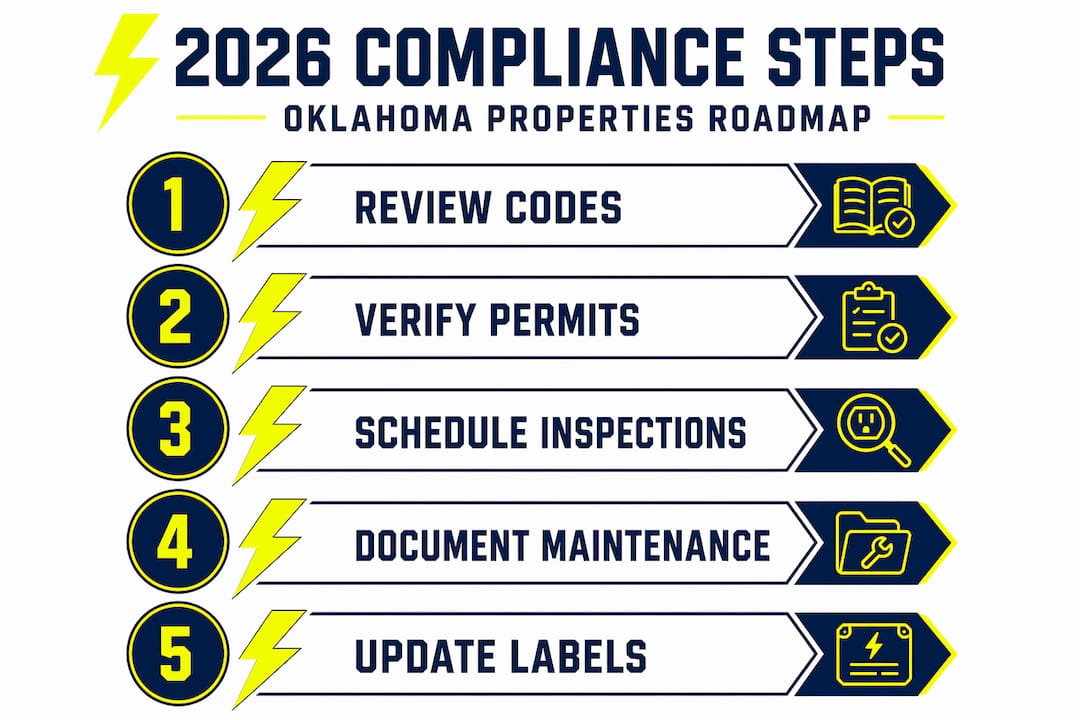
This is where preparation turns into execution. Use the following workflow as your practical compliance checklist for 2026.
Phase 1: Preparation
- Confirm the enforced NEC edition with your local AHJ before pulling any permits.
- Verify that your electrical contractor holds both a state license and any required city registrations in OKC or Tulsa.
- Collect all existing maintenance records, permit history, and arc-flash studies for the property.
- Identify gaps in your equipment inventory and resolve them before scheduling inspections.
Phase 2: Execution
- Submit permit applications through your licensed contractor. Do not attempt owner-pulled permits in jurisdictions that restrict them.
- Complete all required inspections before closing walls or energizing new circuits.
- Conduct or update your arc-flash risk assessment and produce compliant NEC 2026 labels with documented assessment dates.
- Implement your documented EMP or update the existing one to reflect current NFPA 70B mandatory requirements.
Phase 3: Verification and ongoing maintenance
- Confirm all permit records are closed and final inspection sign-offs are on file.
- Store all compliance documentation in a centralized, accessible location.
- Schedule your next EMP review and arc-flash reassessment on the calendar before the year ends.
| Compliance phase | Key action | Who is responsible |
|---|---|---|
| Preparation | Code and permit verification | Property owner or manager |
| Preparation | Contractor credential check | Property owner or manager |
| Execution | Permit application and inspection | Licensed electrical contractor |
| Execution | Arc-flash assessment and labeling | Qualified electrical engineer or contractor |
| Verification | Record storage and review scheduling | Property owner or manager |
Troubleshooting common failures: inspection rejections usually trace back to unlicensed subcontractors, missing permits on prior work, or equipment that does not match the permitted scope. Catching these before the inspection, not during, saves you the cost and delay of re-inspection fees.
For a broader look at how code compliance connects to safety upgrades, the Shepherdelectricalconstruction resource library is worth bookmarking as you plan your 2026 projects.
My honest take on electrical compliance in Oklahoma properties
I have worked with property owners across the Oklahoma City Metro long enough to see the same mistakes repeat themselves. The most damaging one is assuming that state-level code adoption means every jurisdiction is on the same page. It does not. I have seen projects stalled for weeks because a contractor was licensed by the state but not registered with the city. That gap is entirely avoidable.
The second pattern I see is treating documentation as an afterthought. Property managers who have their maintenance records organized walk through inspections in a fraction of the time compared to those scrambling to reconstruct service history. The records are not just paperwork. They are your legal protection when an insurance claim or a sale transaction puts your compliance history under a microscope.
Arc-flash labeling is the compliance gap I am most concerned about heading into 2026. Many properties have labels. Very few have labels tied to a current, documented study with a completion date. That distinction is exactly what NEC 2026 is testing for. If you are not sure whether your labels meet the current standard, assume they do not and schedule an assessment.
My advice: treat electrical compliance as a business process, not a one-time event. Build the maintenance program, set the review schedule, and work with a contractor who knows your local AHJ personally. That relationship pays for itself the first time a question comes up during inspection.
— Brad
How Shepherdelectricalconstruction simplifies your 2026 compliance
Staying ahead of 2026 electrical safety standards is manageable when you have a contractor who understands Oklahoma’s permit requirements, local AHJ relationships, and NFPA 70B obligations inside and out.

Shepherdelectricalconstruction serves Edmond and the Oklahoma City Metro with services that directly support your compliance goals: electrical maintenance programs, panel inspections, arc-flash assessment preparation, permit-ready installations, and safety upgrades. The team holds the state licensing and local registrations required to pull permits correctly in OKC and Tulsa without delays. Browse completed compliance and upgrade projects to see the scope of work the team handles across residential and commercial properties. For wiring upgrades that support code-compliant circuits, the home wiring and dedicated circuits service page covers the most common residential compliance needs in Oklahoma.
FAQ
What NEC edition does Oklahoma enforce in 2026?
Oklahoma enforces the 2023 NEC statewide as of September 14, 2024. All 2026 permit applications and inspections are evaluated against this edition unless local AHJ amendments apply.
Do homeowners need a licensed contractor to pull permits in Oklahoma?
In most Oklahoma jurisdictions, permits must be pulled by a licensed state contractor. Oklahoma City and Tulsa additionally require local city registration before permits are issued.
What is the 5-year arc-flash rule under NEC 2026?
NEC Section 110.16(B) requires that arc-flash labels include the documented date of the hazard study and that studies are reviewed within a 5-year maximum cycle or sooner after major equipment changes.
What happens if electrical work is done without a permit in Oklahoma?
Skipping permits triggers stop-work orders, double permit fees, potential utility refusal to connect, insurance claim denials, and mandatory disclosure obligations when the property is sold.
Is NFPA 70B mandatory for Oklahoma commercial properties?
Yes. NFPA 70B became a mandatory standard in 2023, replacing its previous status as a recommended practice. Commercial facilities must now have a documented electrical maintenance program with defined inspection intervals, qualified personnel, and maintained records.
Recommended
- Electrical code compliance: Safety and efficiency guide
- Electrical inspection checklist: ensure safety and code compliance
- OSHA electrical safety: a guide for Oklahoma property owners
- Safe Electrical Installation Guide for Edmond & OKC Homes
Need help with this at your home?
Shepherd Electrical helps Edmond and OKC metro homeowners with residential electrical service, repairs, upgrades, panels, EV chargers, solar, and backup power. Free estimates are available, and workmanship is backed by a lifetime guarantee.