

TL;DR:
- Electrical hazards are often underestimated on construction sites, and liability increases when safety measures are neglected. Property developers must incorporate electrical safety planning from the start, including RCD protection, regular testing, and proper documentation. Early inspections and safety discipline across all workers are essential to avoid delays, accidents, and legal issues.
Electrical hazards are one of the most underestimated risks on any construction site, and property developers who leave safety planning entirely to contractors pay for it twice: once in potential fines and project delays, and again if someone gets hurt. Understanding the essential electrical safety tips for property developers means recognizing that safety is a developer responsibility from day one, not something that gets sorted out after the build is underway. This article gives you a prioritized, practical breakdown of what to get right before, during, and after construction.
Table of Contents
- Key takeaways
- 1. Electrical safety tips for property developers: know your legal framework
- 2. Set up temporary power correctly from the start
- 3. Install GFCI protection on all relevant receptacles
- 4. Run test-and-tag cycles on all portable equipment
- 5. Enforce lockout/tagout with voltage verification
- 6. Conduct and maintain arc flash studies
- 7. Schedule inspections early and account for lead times
- 8. Treat electrical safety as a site-wide discipline
- 9. Use your property development safety checklist consistently
- My take on where developers go wrong
- Let Shepherd Electrical keep your project safe and compliant
- FAQ
Key takeaways
| Point | Details |
|---|---|
| Developer responsibility starts early | Electrical safety must be planned from project kickoff, not delegated entirely to contractors after work begins. |
| RCD protection is non-negotiable | All sub-circuits and temporary power supplies require residual current device protection rated at 30 mA or less. |
| Test-and-tag on a tight cycle | Portable tools and leads must be tested every three months to stay compliant and catch faults before they injure someone. |
| Documentation protects you legally | Keeping arc flash studies, inspection certificates, and test records current is your best defense in a dispute or audit. |
| Coordination prevents costly delays | Scheduling electrical inspections with utility authorities early avoids late-stage approval bottlenecks that stall entire projects. |
1. Electrical safety tips for property developers: know your legal framework
Before any wire gets run on your site, you need to understand the standards that govern construction electrical work. In the U.S., the National Electrical Code (NEC) and OSHA 29 CFR 1926 set the floor for construction site electrical safety. NFPA 70E adds the layer of arc flash safety requirements that many developers do not discover until an inspector flags a deficiency.
Visual surveys for overhead and buried utility lines are required before any excavation or crane work. NAHB recommends incorporating these into daily site induction and pre-task planning. Skipping this step is the kind of oversight that turns a manageable project into a liability case.
Pro Tip: Have your licensed electrical contractor document every regulatory standard applicable to your specific project type, jurisdiction, and planned occupancy load at the permitting phase. It takes an hour to prepare and can save weeks of correction work later.
2. Set up temporary power correctly from the start
Temporary power is where most construction site electrical problems originate. Developers often treat it as a throwaway setup, yet it is energized for months and used by every trade on site. RCD protection at 30 mA or less is required on all temporary circuits, and construction wiring must be marked with iridescent yellow tape every five meters so workers always know what they are dealing with.
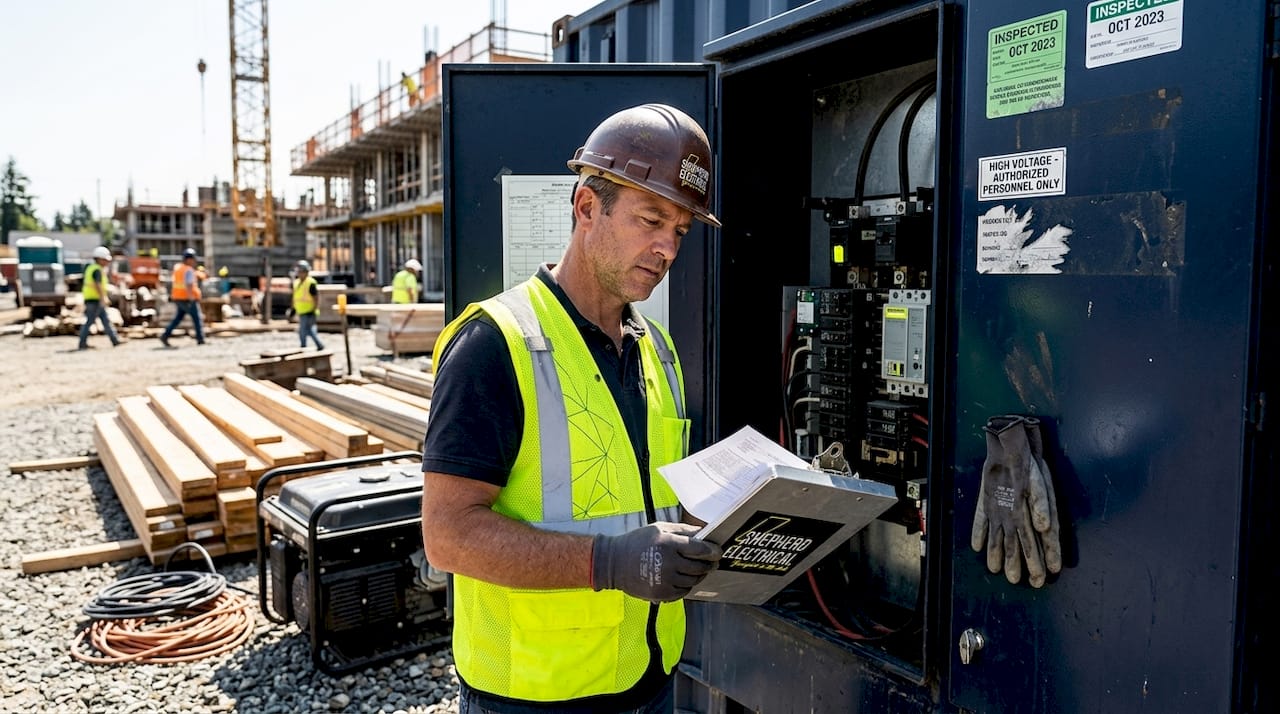
Your main temporary switchboard location matters more than most developers realize. Place it in a sheltered, lockable enclosure with clear labeling, and use mechanically protected cables wherever cords cross traffic areas. Load balancing across distribution boards prevents nuisance trips that halt work unexpectedly in the middle of a pour or a framing push.
3. Install GFCI protection on all relevant receptacles
Ground fault circuit interrupter (GFCI) protection is one of the most cost-effective safety measures on a construction site. Any 120-volt receptacle used outdoors or in wet areas requires GFCI protection under NEC guidelines. This is not optional.
GFCI use on site receptacles substantially reduces the risk of ground fault injuries across all trades, not just electricians. A Shepherdelectricalconstruction licensed electrician can install GFCI devices during the temporary power setup phase so protection is built in from day one rather than retrofitted after an inspection flags the gap.
4. Run test-and-tag cycles on all portable equipment
Every portable power tool, extension lead, and piece of electrical equipment on your site needs to be tested and tagged. Under standards aligned with AS/NZS 3760:2022, testing every three months is the required cycle for construction environments.
This matters for you as a developer because faulty equipment is a leading cause of site injuries, and liability often traces back to whoever controlled the site. Keep a register of all tested equipment, the test dates, and who performed the testing. That record is your documentation if anything is questioned later.
5. Enforce lockout/tagout with voltage verification
Safe isolation is one of the most frequently mishandled procedures in construction. Failure to correctly perform safe isolation is a leading cause of electrical injuries on active sites. The correct sequence is isolate, secure, verify dead using a live-dead-live test, then begin work.
OSHA 29 CFR 1910.147 and NFPA 70E both specify this stepwise approach, which is commonly called lockout/tagout procedure. As a developer, you do not perform this yourself. But you are responsible for requiring that every contractor working on energized or recently de-energized systems follows a documented isolation procedure. Build it into your subcontract requirements.
Pro Tip: Require that your electrical subcontractors submit a job safety analysis (JSA) for any energized electrical work before it begins. This one administrative step significantly reduces the chance of a re-energization incident.
6. Conduct and maintain arc flash studies
Arc flash is not just an electricians’ concern. On projects with systems rated at 1,200 amps or more, arc flash labeling and studies must be current, with mandatory refreshes at least every five years under NEC 2020 requirements. For large-scale or multi-tenant developments, these studies need to be treated as living documents updated whenever the electrical system changes.
Developers managing commercial or mixed-use properties should commission an arc flash hazard analysis during the design phase, not after substantial completion. The cost of the study is minor compared to the cost of re-labeling a completed panel room because the data was outdated before the certificate of occupancy was issued.
Review arc flash risk assessments with your electrical contractor as part of your standard project close-out checklist.
7. Schedule inspections early and account for lead times
In many jurisdictions, temporary electrical service requires notification to the relevant electrical safety authority before energization, with inspection timelines running three to seven business days. That gap stalls your project if you do not plan for it.
Build inspection scheduling into your construction program the same way you schedule concrete pours and framing inspections. Contact your utility and electrical authority at the pre-construction meeting. Know their submission requirements, their timelines, and their preferred documentation format before you need them on short notice.
8. Treat electrical safety as a site-wide discipline
Electrical hazards affect every worker on site, not only the licensed electricians. A framing crew that does not recognize a construction cable or a plumber who does not report a frayed lead is just as much a risk factor as a wiring defect.
Integrate electrical hazard recognition into every site induction. Workers should know how to identify construction wiring, what a tagged-out panel means, and who to report a concern to. Effective electrical safety management combines administrative controls like training and permit systems with technical measures like RCDs and PPE. One without the other leaves gaps.
9. Use your property development safety checklist consistently
A checklist is only useful if it is actually used. Your electrical inspection checklist should cover equipment condition, RCD functionality, test-and-tag currency, cable protection status, and isolation procedure compliance at minimum. Review it weekly, not just at formal inspection milestones.
Assign a specific person on site to own this checklist. When everyone is responsible, no one is. A named site electrical safety contact creates accountability and gives workers a clear escalation path when they spot something wrong.
My take on where developers go wrong
I have seen enough construction projects to know that the gap between safety documentation and actual site practice is usually where incidents happen. Developers often invest in the right hardware and then assume the procedures follow automatically. They do not.
The most overlooked area is temporary power safety. It carries the highest electrical risk during the first half of any project, and it consistently gets the least attention because it feels temporary. Planning your RCD requirements, test-and-tag cycles, and cable protection layout before your contractor mobilizes is not over-preparation. It is how you avoid being the developer who finds out about a wiring problem from an insurer instead of an electrician.
My candid advice: documentation is not just compliance theater. Your arc flash studies, your isolation procedure records, and your inspection certificates are your legal defense if something goes wrong on a project you controlled. Maintain them like they matter, because they do.
— Brad
Let Shepherd Electrical keep your project safe and compliant

Shepherdelectricalconstruction works directly with property developers across the Edmond and Oklahoma City Metro area on everything from temporary power setup to final electrical code compliance sign-off. Whether you need support preparing for inspections, commissioning arc flash studies, or getting urgent electrical issues resolved without stopping your build, the team has the experience to keep your project moving. Browse Shepherd Electrical’s developer project portfolio to see how we support developers from groundbreaking through occupancy.
FAQ
What is the most important electrical safety step for property developers?
Installing RCD protection rated at 30 mA or less on all construction sub-circuits from day one is the single highest-impact safety measure, as it catches ground faults before they cause injury.
How often must portable tools be tested on a construction site?
Portable tools and leads must be tested and tagged every three months in active construction environments to meet current electrical safety standards.
Who is responsible for electrical safety on a construction site?
The developer shares responsibility for site electrical safety alongside the contractor. As the party controlling the site, developers must require documented safety procedures and verified compliance from every subcontractor.
When should arc flash studies be commissioned for a development?
Commission an arc flash study during the design phase, especially for systems rated at 1,200 amps or more. Studies must be refreshed at least every five years under NEC 2020 requirements.
How do I avoid inspection delays on temporary electrical service?
Contact your electrical safety authority at the pre-construction meeting and build their notification and inspection timeline, typically three to seven business days, directly into your construction schedule.
Recommended
- Professional electrical services: boost home safety and value
- Electrical system assessment for safer homes: 2026 guide
- Residential Electrical Panel Hazards – Shepherd Electrical
- Electrician Near Me at Shepherd Electrical
Need help with this at your home?
Shepherd Electrical helps Edmond and OKC metro homeowners with residential electrical service, repairs, upgrades, panels, EV chargers, solar, and backup power. Free estimates are available, and workmanship is backed by a lifetime guarantee.