


TL;DR:
- Outdoor outlets require weatherproof covers and GFCI protection to prevent moisture-related shocks, corrosion, and fire hazards.
- Proper installation includes matching cover types to how the outlet is used and ensuring system components like receptacles, gaskets, and boxes work together as a system.
Outdoor outlets need covers because moisture reaching energized contacts causes ground faults, corrosion, arcing, and fire — and because the National Electrical Code (NEC) and International Residential Code (IRC) require weatherproof in-use covers plus GFCI protection for most exterior receptacle locations.
- Safety: An uncovered outdoor outlet in wet conditions creates a direct shock and fire hazard. Moisture bridges the gap between live contacts and any grounded surface nearby.
- Code compliance: IRC 2024 requires all exterior receptacles on one- and two-family homes to be GFCI-protected, weather-resistant (WR) rated, and fitted with in-use weatherproof covers.
- Practical value: A cover swap or GFCI upgrade is one of the lowest-cost electrical improvements you can make, and it protects appliances, wiring, and the outlet box itself from years of weather damage.
Table of Contents
- What happens when you leave an outdoor outlet uncovered?
- What do NEC and IRC actually require for outdoor outlets?
- Which cover type do you actually need?
- Why the receptacle and cover have to work as a system
- How to inspect and maintain outdoor outlet covers
- What does it cost to fix or upgrade an outdoor outlet cover?
- When to call Shepherdelectricalconstruction for outdoor outlet service
- Key Takeaways
- The part most homeowners get wrong
- Outdoor outlet upgrades done right in Edmond and OKC
- Useful sources
- FAQ
What happens when you leave an outdoor outlet uncovered?
The most immediate risk is shock. Rain, irrigation spray, or even heavy humidity can create a conductive path between the outlet’s live contacts and a person touching a plugged-in cord or wet appliance. Standing on wet grass or damp concrete makes that path even more direct. A standard circuit breaker will not trip fast enough to prevent a fatal shock at those current levels — only a GFCI can respond quickly enough.
Long-term, the damage is quieter but just as serious. Moisture drives corrosion of the brass and copper terminals inside the outlet. As those contacts corrode, resistance climbs, and higher resistance means heat. That heat can eventually produce arcing faults — the kind that ignite nearby wood framing or insulation without tripping a breaker. You might notice the outlet running warm, appliances behaving erratically, or the GFCI tripping repeatedly before anything visible goes wrong.
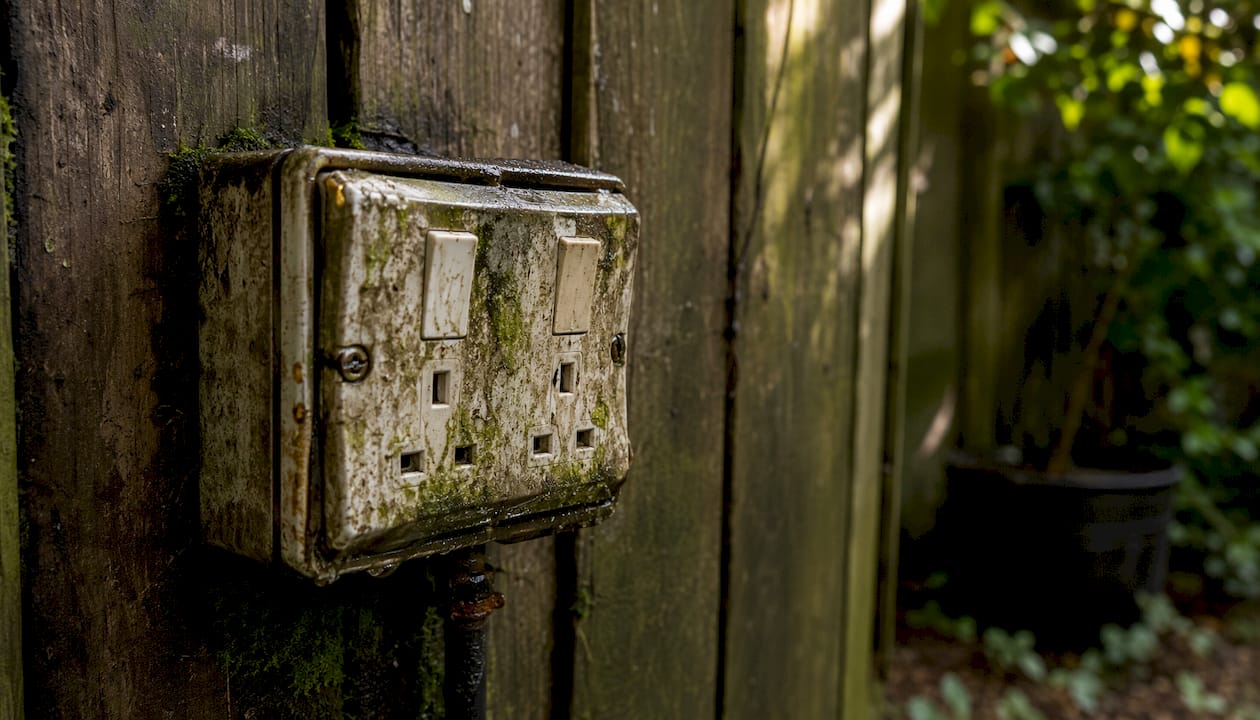
There’s also a broader hazard worth knowing: improper extension cord use through windows and doors contributes to more than 3,000 fires and roughly 50 deaths annually, according to CPSC estimates cited by Jaspector. That number reflects what happens when people work around missing or inadequate outdoor outlets. A properly covered, GFCI-protected exterior outlet removes the temptation to run an indoor cord outside.
Common failure scenarios:
- Pressure washer plugged in while spraying nearby surfaces
- Holiday lights left plugged in through a rainstorm with a flat flip-lid cover
- Outlet on an unprotected exterior wall with no cover at all, corroding silently for years
- Water pooling inside the box after a heavy Oklahoma storm, then drying and leaving mineral deposits on the terminals
If you’re seeing a dead outlet or one that trips repeatedly, moisture damage is often the cause.
What do NEC and IRC actually require for outdoor outlets?
The core rule is straightforward: GFCI protection for outdoor receptacles has been required by the NEC since 1971. Modern code goes further, layering in WR-rated devices and the correct cover type based on exposure level.
Wet vs. damp locations — the distinction that drives cover choice:
- Wet location: Exposed to weather, saturation, or direct water contact. An outlet on an unprotected exterior wall, near a pool, or on an open deck qualifies. Wet locations require an enclosure that stays weatherproof even while a cord is plugged in — meaning an in-use (bubble) cover is mandatory.
- Damp location: Protected from direct weather but still exposed to condensation or indirect moisture. A covered porch or carport outlet often falls here. The enclosure must be weatherproof when the cover is closed and no plug is inserted.
Being under a roof overhang does not automatically make an outlet “damp” rather than “wet.” If cords are routinely left plugged in during rain, inspectors treat it as a wet-during-use location.
| Location type | Cover required | GFCI required | WR receptacle required |
|---|---|---|---|
| Wet (open deck, yard, pool area) | In-use (bubble/extra-duty) | Yes | Yes |
| Damp (covered porch, carport) | Weatherproof flip-lid (when not in use) | Yes | Yes |
| Near pool/spa | In-use, extra-duty | Yes | Yes |
At final inspection, the inspector tests GFCI operation, checks that the cover opens fully, and verifies the WR marking on the receptacle face. A WR GFCI in an indoor box with a decorative cover fails inspection even if the GFCI itself works.
Which cover type do you actually need?
The answer depends on how the outlet gets used, not just where it sits.
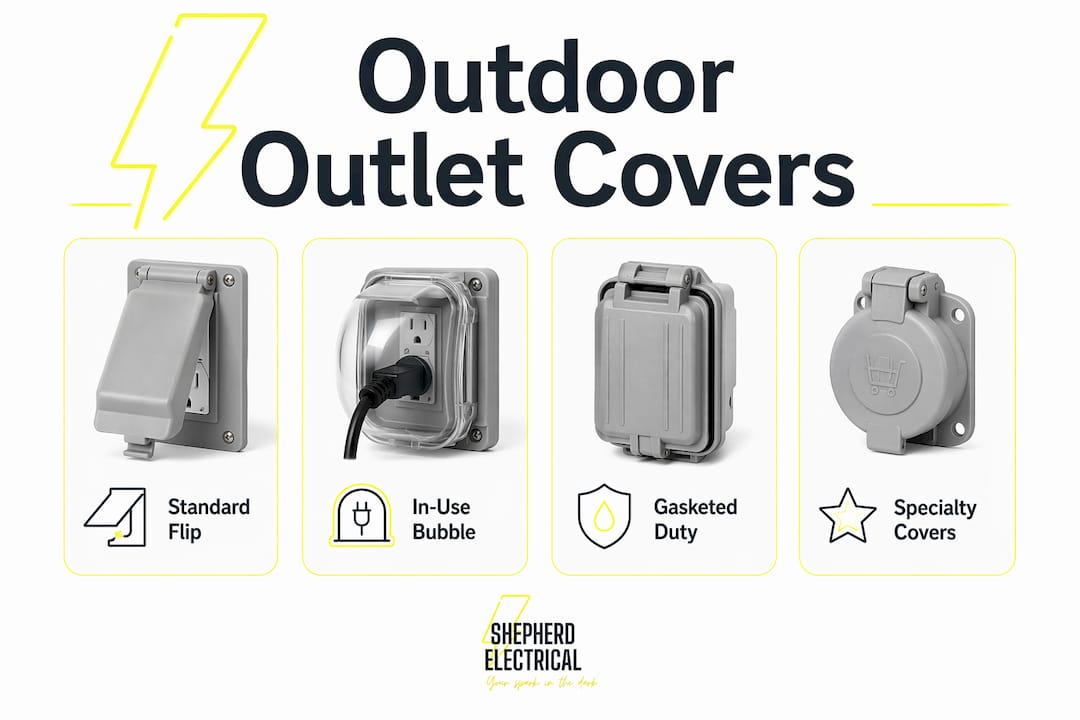
Standard flip-lid (closed weatherproof): Protects the outlet when nothing is plugged in. The lid snaps shut over the receptacle face. Fine for a damp-location outlet used occasionally with someone present the whole time. Completely inadequate if a cord stays plugged in during rain.
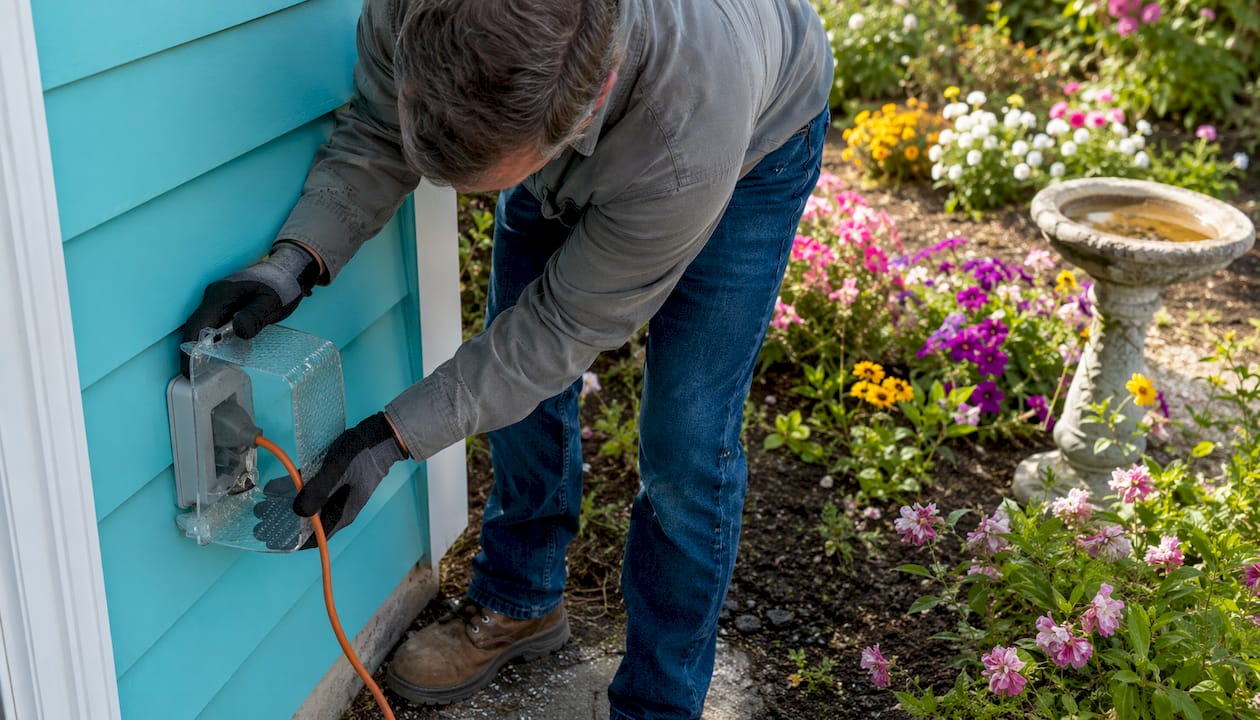
In-use (bubble) cover: A domed or box-shaped hood that closes around an inserted cord, keeping the connection weatherproof while the plug is in. Inspectors require these in wet locations because a standard flip-lid leaves the outlet fully exposed the moment a cord is inserted. Most front and rear yard outlets, deck outlets, and any outlet near a pool or spa need this type.
Gasketed extra-duty covers: A step up in durability — thicker housing, UV-stabilized materials, and a compression gasket that maintains a seal over years of temperature cycling. The NEC requires outlet box hoods in wet locations to be listed and identified as “extra-duty.” This is not optional wording on the packaging; it’s a code requirement.
Specialty covers (EV, pool, spa): Higher-amperage or NEMA-specific configurations for dedicated circuits. These follow the same wet/damp logic but are sized and listed for their specific load.
| Cover type | Weatherproof while in use | Gasket present | UV resistant | Best for |
|---|---|---|---|---|
| Standard flip-lid | No | Sometimes | Varies | Damp locations, attended use only |
| In-use (bubble) | Yes | Yes | Yes (extra-duty) | Wet locations, cords left plugged in |
| Gasketed extra-duty | Yes | Yes | Yes | All wet locations per NEC |
| Specialty (EV/pool) | Yes | Yes | Yes | Dedicated circuits, pool/spa areas |
Pro Tip: Always buy a cover and receptacle from the same listed system when possible. The gasket depth, screw spacing, and hood clearance are engineered together. Mixing brands can leave gaps that defeat the weatherproofing entirely.
Why the receptacle and cover have to work as a system
Swapping just the cover without checking the receptacle underneath is one of the most common outdoor outlet mistakes. WR receptacles have been required by the NEC since the 2008 code cycle specifically because standard indoor devices fail quickly outdoors. UV exposure degrades the nylon face, temperature swings stress the internal contacts, and corrosion attacks the terminals in ways that indoor testing never accounts for.
The WR marking on the receptacle face means the device was tested for UV resistance, temperature cycling from extreme cold to heat, and dielectric integrity under those conditions. A plain white indoor GFCI outlet does not carry that rating, even if it looks identical.
Covers and receptacles are listed as a system for wet and damp locations. That means:
- The box must be an exterior-rated metal or PVC box with a proper gasket
- The receptacle must carry the WR marking
- The hood must be listed and marked “extra-duty” for wet locations
- The lid hinge must clear siding, trim, and any offset so it opens at least 90 degrees
That last point trips up a lot of installations. A cover that can’t open fully because it hits the siding is a code failure and a practical problem — lids forced against an obstruction crack and stop sealing within a season. If you’re wondering why outlets go bad faster outdoors, a mismatched or partially obstructed cover is often part of the answer.
How to inspect and maintain outdoor outlet covers
Run through this checklist once a season, especially after Oklahoma’s hail and storm season:
- Check the gasket. Press the lid closed and look for gaps. A compressed or cracked gasket no longer seals. Replace the cover.
- Open the lid fully. It should swing at least 90 degrees without hitting siding, trim, or a short nipple. If it stops short, the cover needs to be replaced or the box needs to be extended.
- Look for cracking or sun-brittleness. UV-degraded plastic covers feel chalky and crack under light pressure. They’re no longer listed for the application.
- Check the WR marking. Look at the receptacle face for the letters “WR.” If it’s not there, the receptacle needs to be replaced regardless of how new it looks.
- Test the GFCI. Press the test button. The outlet should go dead. Press reset. Power should return. A GFCI that won’t reset or won’t trip on test needs to be replaced — see why a GFCI won’t reset for more on that.
- Open the cover and look inside the box. Visible corrosion on the terminals, water staining, or mineral deposits mean moisture has been getting in. Don’t use the outlet until a licensed electrician inspects it.
Common mistakes to avoid:
- Using a flat indoor cover plate outdoors
- Installing a flip-lid cover on an outlet where cords stay plugged in overnight
- Forgetting to check hinge clearance before finalizing the cover position
- Replacing only the cover without verifying the WR marking on the receptacle
Pro Tip: Shut off the circuit at the breaker before removing any cover for inspection. Even a visual check inside the box is safer with the power off.
Call a licensed electrician when you see corrosion on the terminals, water pooling inside the box, or a GFCI that keeps tripping. Those are not cover problems — they’re wiring problems that need professional electrical repair.
What does it cost to fix or upgrade an outdoor outlet cover?
Costs vary based on what the outlet actually needs:
- Cover replacement only (box and receptacle are healthy): Low cost, often a straightforward job if the box is accessible and the existing receptacle is WR-rated. Labor is typically under an hour.
- WR GFCI receptacle swap (cover plus new receptacle): Moderate cost. Adds the time to wire the new device and test GFCI operation. Most single-outlet upgrades fall in this range.
- Box replacement or relocation: Significantly more labor. Required when the existing box is corroded, the wrong type, or positioned where a cover can’t open fully. Factor in patching and finishing if the box moves.
- GFCI breaker upgrade: Protects an entire circuit rather than a single outlet. Higher upfront cost but covers multiple receptacles at once — worth considering for older homes with several unprotected exterior outlets.
Most homeowners in Edmond and the OKC area can have a single outdoor outlet cover and receptacle upgraded in one service visit. A full exterior inspection that catches multiple problem outlets may take longer depending on the number of locations and the condition of the existing boxes.
When to call Shepherdelectricalconstruction for outdoor outlet service
If your inspection checklist turns up corrosion, a GFCI that won’t reset, a cover that won’t seal, or water inside the box, stop using that outlet and call. Shepherdelectricalconstruction serves homeowners in Edmond, North OKC, NW OKC, Deer Creek, The Village, Nichols Hills, Arcadia, Jones, and surrounding Oklahoma City neighborhoods.
What a service visit looks like:
- Power is isolated at the breaker before any cover or receptacle is touched
- The cover, receptacle, box, gasket, and visible wiring are all inspected
- The crew recommends the correct WR receptacle and in-use cover combination for the exposure level
- Repairs are completed and GFCI operation is tested before the job is closed
Call or text (405) 406-1026 or use online booking to schedule. All work follows NEC and NFPA standards. For outlet and switch repair or a full exterior inspection, the booking path is the same.
Key Takeaways
Outdoor outlets need covers because moisture contact with energized components causes shock, corrosion, arcing, and fire — and NEC/IRC require in-use covers plus GFCI protection for wet-location receptacles.
| Point | Details |
|---|---|
| Moisture causes real damage | Corrosion raises terminal resistance, generates heat, and leads to arcing faults and fire over time. |
| Code requires in-use covers | NEC/IRC 2024 mandates GFCI protection, WR-rated receptacles, and in-use covers for wet outdoor locations. |
| Cover type must match exposure | Flip-lid covers are insufficient where cords stay plugged in during rain; in-use (bubble) covers are required. |
| Receptacle and cover are a system | A WR receptacle alone does not satisfy code; the box, gasket, extra-duty hood, and hinge clearance all matter. |
| Shepherdelectricalconstruction handles it locally | Serving Edmond and nearby OKC areas, Shepherdelectricalconstruction inspects, upgrades, and tests outdoor outlets to NEC standards. |
The part most homeowners get wrong
The conversation about outdoor outlet covers almost always focuses on the cover itself. That’s the wrong place to start. The cover is the last line of a system that includes the box type, the gasket, the receptacle rating, and the GFCI protection upstream. A beautiful new bubble cover on a corroded, non-WR receptacle in an indoor box is still a code failure and still a hazard.
What I see repeatedly in Edmond and across the OKC metro is outlets that were upgraded partway. Someone replaced the cover after a home inspection flagged it, but the receptacle underneath is still a standard indoor device from 2003. Or the new cover hits the brick veneer and can’t open past 45 degrees, so it cracks by the following spring. The fix looks done, but the protection isn’t there.
Oklahoma’s weather makes this more urgent than it might be in a drier climate. The combination of summer heat, humidity, and severe storm seasons puts outdoor electrical components through more stress than the national average. A gasket that holds up fine in Phoenix may fail in two seasons here. That’s not a reason to avoid outdoor outlets — it’s a reason to get the whole system right the first time and check it once a year.
Outdoor outlet upgrades done right in Edmond and OKC
Shepherdelectricalconstruction installs WR receptacles, in-use covers, GFCI replacements, and full box upgrades for homeowners across Edmond, NW OKC, The Village, Nichols Hills, and surrounding neighborhoods. The difference from a hardware-store cover swap is that every component gets checked: box type, gasket condition, receptacle rating, hinge clearance, and GFCI function. Nothing gets signed off until the whole system works.

If your outdoor outlet has a cracked cover, a non-WR receptacle, or a GFCI that’s been tripping, that’s the job. Shepherdelectricalconstruction handles it in one visit, to code, with no guesswork about which cover type your exposure level actually requires. For residential wiring and receptacle upgrades or a full exterior inspection, call or text (405) 406-1026 or book online at shepherdelectricalconstruction.com.
Useful sources
Authoritative references for the code points and safety guidance in this article:
- ESFI Outdoor Electrical Safety Guide: Covers outdoor outlet safety practices, GFCI requirements near pools and spas, and keeping outlets covered between uses.
- Jaspector — IRC 2024 Outdoor Receptacle Requirements: Detailed breakdown of front/rear receptacle placement, GFCI, WR, and in-use cover requirements under the current IRC.
- Jaspector — IRC 2018 Outdoor GFCI: Explains the location-based GFCI rule and how covered porches and carports are still classified as outdoor locations.
- EC&M — Receptacles in Damp or Wet Locations: NEC code Q&A on damp vs. wet location definitions, extra-duty hood requirements, and WR receptacle testing.
- EC&M — Weather-Resistant vs. Weatherproof Receptacles: Explains the WR marking, what testing it requires, and why it was added to the NEC.
- Eaton — NEC 2023 Receptacle Updates: Technical guidance on damp and wet location cover requirements, 90-degree hinge rule, and extra-duty listings.
- ASMR Education — WR Outlet Cover Purpose and NEC Code: Explains corrosion risk, arcing faults, and how WR covers and receptacles work together for high-exposure locations.
Always verify requirements with your local Authority Having Jurisdiction (AHJ) before a retrofit or new installation. Jurisdictions may adopt different NEC or IRC cycles, and local amendments can add requirements beyond the base code. This article is general information, not a substitute for a licensed electrician’s on-site assessment or your local inspector’s ruling.
FAQ
Do outdoor outlets really need covers if they’re under a roof?
Yes. A covered porch or carport outlet is still classified as an outdoor location under IRC and NEC rules, and still requires GFCI protection, a WR-rated receptacle, and the correct cover for its exposure level.
What happens if rain gets into an outdoor outlet?
Moisture reaching energized contacts can cause an immediate ground fault or shock hazard, and repeated exposure corrodes the brass and copper terminals, raising resistance and eventually producing arcing faults that can start a fire.
What happens if an outdoor outlet has no GFCI protection?
Without GFCI protection, a ground fault that would otherwise trip the device in milliseconds can deliver a fatal shock — a standard circuit breaker responds far too slowly to protect a person in wet outdoor conditions.
Is it safe to use an outlet with a cracked or missing cover?
No. A cracked or missing cover leaves the outlet’s contacts exposed to moisture, insects, and debris. Even brief rain exposure on an uncovered outlet creates shock and fire risks; replace the cover before using the outlet again.
How do I know if my outdoor outlet needs a bubble cover or a standard flip-lid?
If cords stay plugged in while the outlet is exposed to rain or spray — holiday lights, a patio appliance, a pressure washer — you need an in-use (bubble) cover. A standard flip-lid only protects the outlet when nothing is plugged in, which is exactly when protection matters least.
Recommended
- How to Maintain Commercial Outlets: 2026 Safety Guide
- How to test electrical outlets for safety and efficiency
- Why Protect Electrical Systems: Safety and Savings Guide
Need help with this at your home?
Shepherd Electrical helps Edmond and OKC metro homeowners with troubleshooting, repairs, GFCIs, outlets, and safety inspections. Free estimates are available, and workmanship is backed by a lifetime guarantee.