

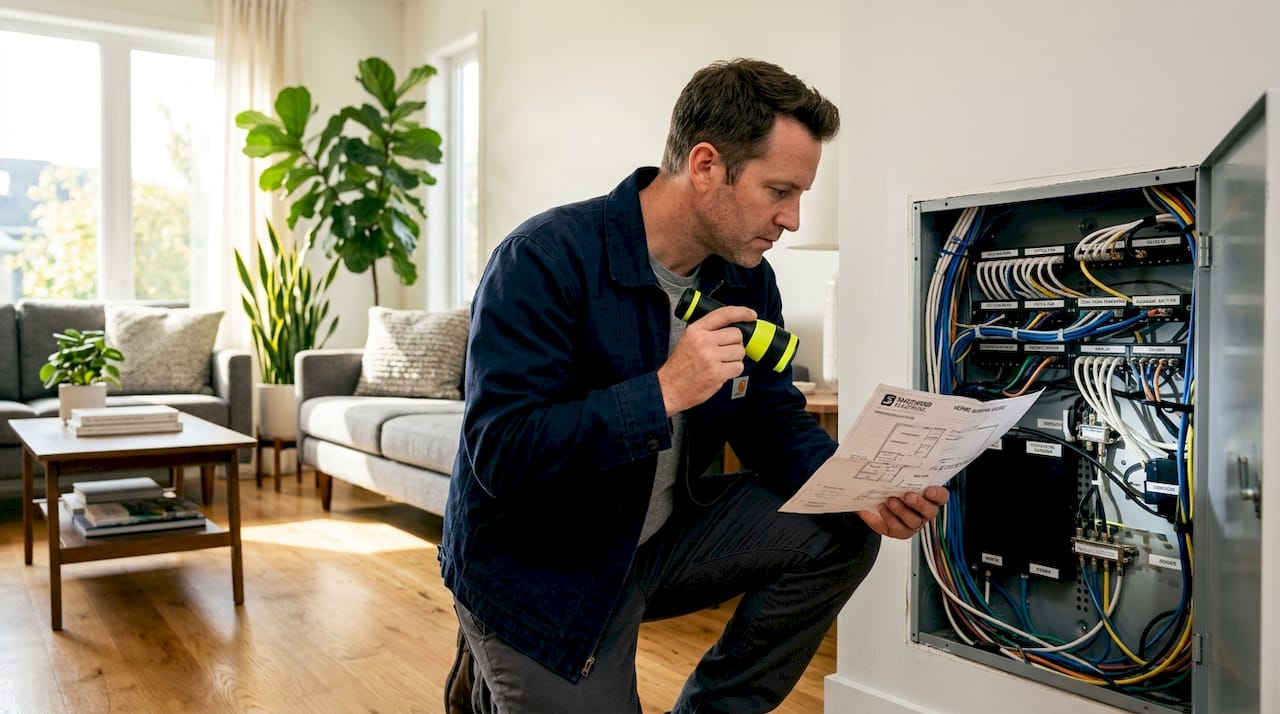
Most homeowners assume all wiring in a home works the same way. You flip a switch, power flows, problem solved. But when your Wi-Fi drops mid-video call, your smart thermostat loses connection, or your security cameras lag, that assumption starts to crack. Structured wiring is what separates a home that handles modern technology reliably from one that constantly fights against it. This guide explains what structured wiring is, why it matters, and how to approach it the right way.
Table of Contents
- Key takeaways
- What structured wiring is and how it works
- Benefits of structured wiring for homeowners
- Labeling, standards, and documentation
- How structured wiring installation works
- Practical tips for upgrading your wiring
- My take: wiring is infrastructure, not an upgrade
- Ready to upgrade your home’s wiring?
- FAQ
Key takeaways
| Point | Details |
|---|---|
| Structured wiring is a system | It organizes all low-voltage cabling into a centralized, manageable infrastructure. |
| Standards exist for a reason | ANSI/TIA-570-B sets minimum cable specs to support smart home and high-speed internet needs. |
| Documentation is not optional | Proper labeling and records prevent costly troubleshooting headaches for years to come. |
| DIY carries real risks | Improper installation can cause code violations, voided insurance, and electrical hazards. |
| It pays off long-term | A well-installed system raises home value and makes future upgrades far less disruptive. |
What structured wiring is and how it works
The structured wiring definition comes down to this: it is a standardized system of low-voltage cables and connection points installed in a home to handle data, video, telephone, security, and automation signals. Unlike the patchwork of cables most older homes have collected over decades, structured cabling systems are planned before walls go up or during a major renovation.
At the core of every structured wiring system is a centralized location called a structured media enclosure or distribution panel. Think of it as the home’s connectivity hub. Every cable in the house runs back to this single point, making it easy to manage, test, and change connections without tearing into walls.
The most common cable types you will find in a structured wiring system include:
- Cat5e or Cat6 Ethernet cables for high-speed data and internet connections
- 75-ohm coaxial cables for cable television and satellite signals
- Fiber optic cables for properties requiring maximum bandwidth capacity
- Telephone cables for landline or intercom systems
The ANSI/TIA-570-B Grade 2 standard recommends at least two four-pair UTP cables (Cat5e or higher) and two 75-ohm coaxial cables at every information outlet in a home. That specification reflects what it actually takes to support smart home needs, high-speed internet, and in-home video at the same time.
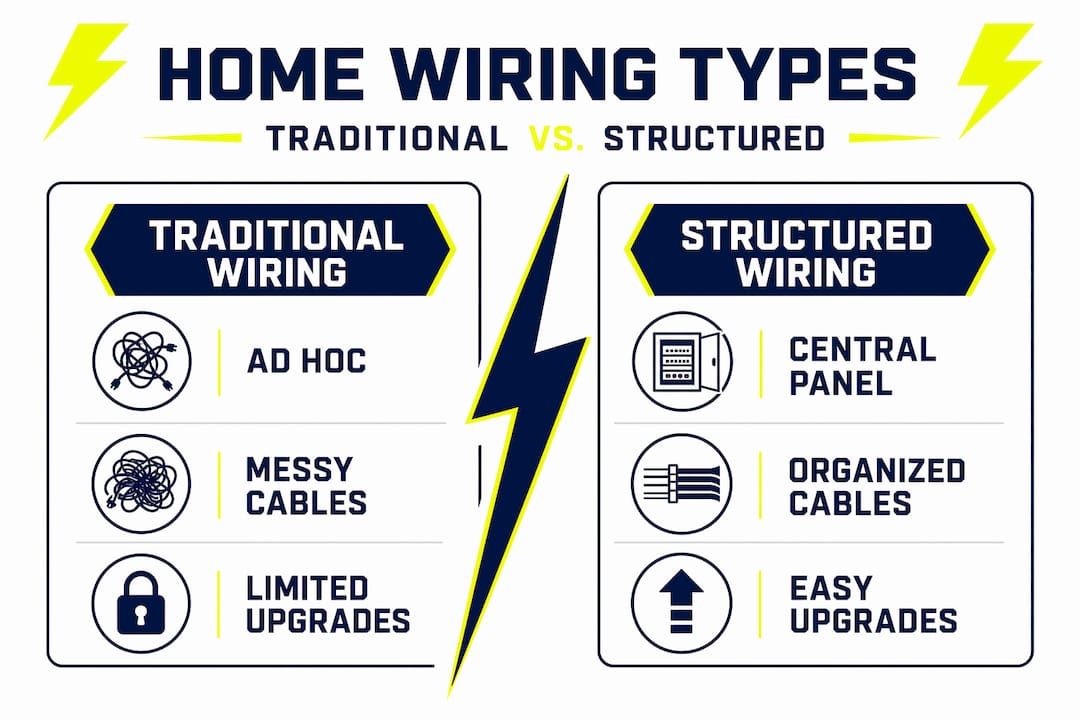
Here is a quick comparison of structured wiring versus traditional wiring:
| Feature | Traditional wiring | Structured wiring |
|---|---|---|
| Organization | Ad hoc, per project | Planned, centralized |
| Scalability | Requires new cable runs | Reconfigure from the panel |
| Documentation | Rarely exists | Required by standard |
| Performance | Inconsistent | Consistent, high-quality signal |
| Smart home support | Limited | Built-in |
Benefits of structured wiring for homeowners
The benefits of structured wiring go well beyond faster internet. The real payoff is in how much easier your home becomes to manage, upgrade, and sell.
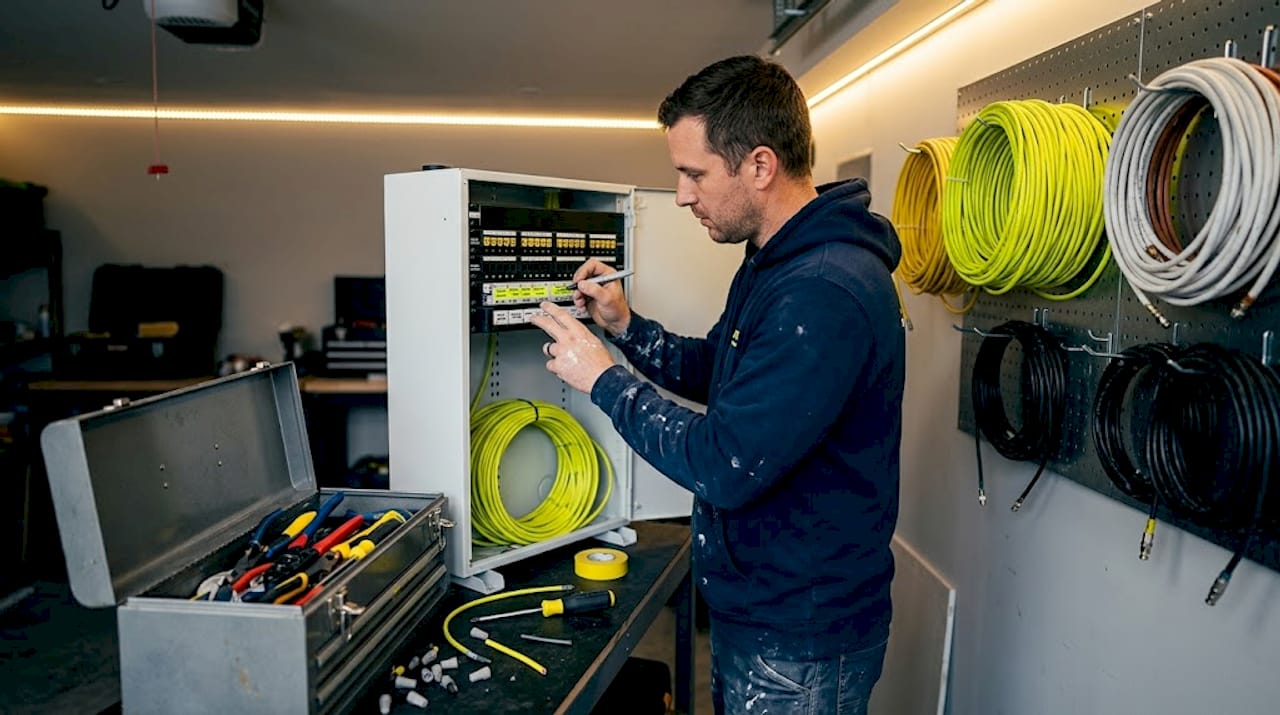
Manageability tops the list. Because every cable routes back to one central panel, you or your electrician can change which device connects to which service without ever touching a wall. Centralizing connections reduces long-term costs by eliminating the need for repeated cable pulls through finished walls. That alone is worth the upfront investment.
Scalability means your home can grow with your technology needs. Adding a new security camera, upgrading to a mesh Wi-Fi system, or integrating smart home automation becomes a far simpler task when your infrastructure already supports it. You are not retrofitting. You are expanding.
Safety matters more than most people realize. Structured wiring reduces the risk of overloaded circuits, improperly routed cables, and interference between systems. Electrical hazards tied to disorganized wiring are a real concern, and a properly installed system addresses them at the root.
Home value is the benefit property managers tend to care about most. Professionally installed wiring is increasingly a selling point because buyers now expect smart home readiness and reliable connectivity as baseline features, not upgrades.
Pro Tip: If you are planning any renovation that opens walls, treat it as your best window to install or upgrade structured wiring. The disruption is already happening. Take advantage of it.
Labeling, standards, and documentation
One of the most overlooked parts of structured cabling systems is the paper trail. Or more accurately, the digital trail.
The TIA-606 labeling standard requires a unique identifier on every cable, placed near both ends, and linked to documented records. Those records tell you what every cable does, where it runs, and what it connects. Without them, you are left guessing.
Here is why proper documentation matters in practice:
- Troubleshooting speed. The TIA-606 hierarchical identifier scheme allows technicians to trace any cable end-to-end in under a minute. That kind of speed is only possible when labels and records exist and match each other.
- Upgrade planning. When you decide to add a home theater or a new smart device zone, documented wiring tells you exactly what capacity you have available without exploratory guesswork.
- Compliance and resale. A wiring system with no matching administration records is non-compliant under TIA-606, which can complicate home sales and professional service calls alike.
- Safety tracking. Most homeowners do not realize that TIA-606 applies to grounding and bonding infrastructure as well, not just data cables. Those components are safety-critical.
Undocumented wiring is one of the most common hidden costs in home renovations. What should be a simple upgrade turns into a detective job, and you pay for every hour of that investigation.
Keep your documentation in a digital format you can update. A shared folder with labeled photos, cable maps, and a simple spreadsheet beats a handwritten note stapled inside a panel door.
How structured wiring installation works
Understanding what structured wiring does is one thing. Knowing what the installation actually involves helps you prepare and ask the right questions before a single cable gets pulled.
A professional structured wiring installation typically follows this sequence:
- Planning and design. A technician maps where outlets, panels, and devices will be located. Every future need gets factored in at this stage, not after walls are closed.
- Cable pulling. Cables run from the central media enclosure to each outlet location. Getting this right requires proper routing to avoid interference with electrical lines and to meet NEC code requirements.
- Termination. Each cable gets terminated at a keystone jack or patch panel. Patch panels and keystone jacks allow flexible connections and easy reconfiguration without opening walls later.
- Labeling and testing. Every connection gets labeled according to TIA-606 standards and tested for signal integrity before anything gets closed up.
One critical detail that DIYers consistently get wrong: mixing cable categories. Mixing Cat6 cables with Cat5e jacks drops performance to the weakest component. You may pay for Cat6 speeds and get Cat5e results because one component did not match.
DIY structured wiring is a significant source of code violations, including miswiring that causes electrical fires, and some insurance providers use NEC violations as grounds to deny claims. A licensed electrician familiar with both the NEC and TIA standards closes that risk gap entirely.
Pro Tip: Ask any contractor you hire to provide the final cable documentation as part of the job. If they will not, that is a signal to look elsewhere.
For existing homes, installation disruption depends heavily on wall access. A full retrofit in a finished home takes longer than new construction, but a structured residential wiring workflow planned by a professional minimizes that disruption significantly.
Practical tips for upgrading your wiring
Whether you are starting from scratch or assessing an older home, these steps give you a clear path forward.
- Audit what you have. Walk your home and document every cable outlet you can find. Identify what each one connects to and what cable type it uses. If you cannot tell, that is a documentation problem worth fixing now.
- Map future needs. Think five to ten years ahead. Where will you want Wi-Fi access points? Security cameras? A home theater? Plan cable runs to those locations before walls close.
- Choose cable specs thoughtfully. For new runs, Cat6 is the current standard for data. Do not cheap out by installing Cat5e when Cat6 costs only marginally more. The future bandwidth demands of smart home technology will use every bit of that extra capacity.
- Commit to documentation from day one. Label every cable yourself if you are doing small additions, and keep a digital record. A $10 label maker and a free spreadsheet prevent hours of future confusion.
- Schedule a professional inspection. Homeowners and property managers routinely underestimate wiring complexity and pay for those gaps through costly mistakes later. A licensed electrician can assess your current setup and identify what needs to change before those changes become urgent.
- Plan for integration. Structured wiring for homes works best when security, audio, video, and data systems all connect through the same centralized panel. That integration requires upfront planning, not an afterthought.
My take: wiring is infrastructure, not an upgrade
I have been working in and around residential electrical systems long enough to see a clear pattern. Homeowners treat wiring like wallpaper. It is invisible until something goes wrong, and then it is suddenly the most expensive problem in the house.
The homes that handle smart technology gracefully, the ones where everything connects reliably and upgrades happen without drama, all share one thing. Someone made intentional decisions about the wiring before the technology arrived. That is the core idea behind structured wiring. It is not about what you need today. It is about not tearing your walls apart in three years when your needs change.
I see DIY wiring jobs regularly, and the mistakes are almost always the same. Wrong cable category, no labels, cables routed too close to electrical lines, and no documentation whatsoever. The homeowner saved a few hundred dollars on installation and then paid double that in troubleshooting the first time something stopped working.
Properly planned wiring is also one of the few home improvements that makes your property genuinely easier to sell. Buyers who care about smart home features, which is an increasingly large share of buyers, can tell the difference between a patchwork system and one that was built with intention.
My honest advice: treat your home’s cabling infrastructure the same way you treat the electrical panel or the HVAC system. Get it done right by someone who knows the standards, document everything, and you will not think about it again for a very long time.
— Brad
Ready to upgrade your home’s wiring?
If this article made you look at your current wiring setup and wonder whether it measures up, that instinct is worth following. Shepherdelectricalconstruction serves homeowners and property managers throughout Edmond and the Oklahoma City Metro area, providing professional structured wiring installation, smart home wiring upgrades, and full electrical inspections.

Every project follows NEC safety codes and TIA standards, and every installation comes with proper documentation you can actually use. Whether you are building new, renovating, or just want an honest assessment of what you have, the team at Shepherdelectricalconstruction is ready to help. Learn more about what electrical contractors do or explore the full range of electrical services available to find the right starting point for your home.
FAQ
What is structured wiring in a home?
Structured wiring is a standardized system of low-voltage cables organized around a central distribution panel, designed to handle data, video, security, and automation signals throughout a home. It replaces the unplanned, piecemeal wiring that most homes accumulate over time.
What does structured wiring do for smart home devices?
It provides the reliable, high-bandwidth signal paths that smart home devices depend on. Without it, devices like security cameras, smart speakers, and automation controllers often experience interference, lag, or dropped connections.
How long does structured wiring installation take?
For new construction, installation typically runs alongside other rough-in work and adds minimal time. For existing finished homes, a retrofit can take one to three days depending on the home size and the number of outlet locations planned.
Is structured wiring worth the cost?
Yes. A professionally installed system raises home resale value, reduces future upgrade costs, and prevents the safety and insurance risks that come with code-violating DIY wiring. The upfront cost is reliably lower than fixing problems after the fact.
Can I install structured wiring myself?
Technically possible in some areas, but not recommended. DIY installations are among the most common sources of NEC code violations and can result in denied insurance claims or safety hazards. A licensed electrician with structured cabling experience closes those risks at the source.
Recommended
- Residential wiring workflow: safer, more efficient homes
- Smart home wiring: upgrade your Edmond or OKC property
- Upgrade Your Home Wiring for Safety and Efficiency
Need help with this at your home?
Shepherd Electrical helps Edmond and OKC metro homeowners with residential installs, wiring upgrades, fans, lighting, and electrical improvements. Free estimates are available, and workmanship is backed by a lifetime guarantee.