


Every year, 7,400 electrical fires break out in non-residential buildings across the U.S., causing over $354 million in losses. Most are preventable. If you manage a commercial property or run a business from one, a solid commercial electrical maintenance guide is not just a resource you should skim once. It is the framework that keeps your people safe, your systems running, and your facility compliant with NFPA, OSHA, and local codes. This article walks you through building that framework from the ground up.
Table of Contents
- Key takeaways
- Your commercial electrical maintenance guide starts here
- Executing preventive maintenance tasks and schedules
- Common maintenance challenges and how to troubleshoot them
- Verifying and documenting your maintenance program
- My take on why most programs fall short
- How Shepherdelectricalconstruction can support your maintenance program
- FAQ
Key takeaways
| Point | Details |
|---|---|
| Start with a written program | NFPA 70B requires a documented Electrical Maintenance Program covering scope, intervals, and personnel. |
| Risk-based prioritization matters | Assess equipment criticality first so maintenance resources go where failure would hurt most. |
| Safety rules govern every task | NFPA 70E arc-flash and Lock-Out/Tag-Out protocols apply to all energized electrical work. |
| Documentation equals compliance | Missing inspection records are treated as missing maintenance by OSHA and insurance auditors. |
| Test emergency lighting properly | Monthly 30-second tests and annual 90-minute discharge tests are required under NFPA 101. |
Your commercial electrical maintenance guide starts here
Before you schedule a single inspection, you need a foundation. That foundation is a written Electrical Maintenance Program, commonly called an EMP. NFPA 70B now requires this document to be a repeatable management process, not just a checklist someone prints each quarter. It should define scope, inspection intervals, testing methods, and the qualifications of everyone who touches the work.
Build your equipment inventory first
You cannot maintain what you have not cataloged. Walk your facility and document every piece of electrical equipment: service entrance gear, switchgear, panelboards, motor control centers (MCCs), transformers, automatic transfer switches, circuit breakers, and any emergency or exit lighting systems. This inventory becomes the backbone of your maintenance of electrical systems plan, and it makes scheduling far more manageable.
Once the inventory exists, run a baseline condition assessment on each piece of equipment. The goal is to understand what you have, how old it is, and whether it already shows signs of wear or damage. From there, risk-based prioritization lets you rank assets by criticality. Equipment whose failure would trigger a building-wide outage or a safety incident gets the most frequent attention. Equipment in low-occupancy storage areas gets less.
What NFPA 70E adds to your program
The guide to commercial electrical maintenance does not stop at equipment lists. NFPA 70E governs how your team interacts with live electrical systems. Before any energized work, arc-flash risk assessments are mandatory to determine PPE requirements and approach boundaries. Work that exceeds 40 cal/cm² incident energy is outright prohibited under the standard.
Any task performed within the restricted approach boundary requires a completed Energized Electrical Work Permit. That is paperwork you need before someone starts work, not after. Partnering with qualified electrical professionals who carry documented training on equipment construction, operation, and hazards is not optional under NFPA 70B. It is a requirement.
Key equipment categories to include in your EMP:
- Service entrance equipment and main switchgear
- Distribution panelboards and sub-panels
- Transformers (dry-type and liquid-filled)
- Motor control centers and variable frequency drives
- Automatic transfer switches and emergency generators
- Emergency and exit lighting systems
- Ground-fault circuit interrupter (GFCI) and arc-fault circuit interrupter (AFCI) devices
Pro Tip: When conducting baseline assessments, photograph all equipment nameplates and load readings. This creates a visual record that makes year-over-year comparisons far easier and gives auditors exactly what they want to see.
Executing preventive maintenance tasks and schedules
Knowing what to maintain and actually maintaining it are two different things. This section covers how to maintain electrical equipment at a pace and depth that satisfies NFPA 70B and keeps your systems healthy long-term.
The standard organizes maintenance around time-based intervals: monthly, quarterly, annually, and every three to five years for major equipment. The tasks at each level get more involved as the interval grows. Here is how that plays out across your facility:
- Monthly: Visual inspections of all panelboards for heat, discoloration, or unusual sounds. Functional test of emergency and exit lighting (30-second activation per NFPA 101). Check ground-fault devices by pressing test and reset buttons.
- Quarterly: Inspect cable trays, conduit runs, and junction boxes for physical damage. Verify that breaker labeling is accurate and legible. Check any HVAC-connected electrical equipment for vibration or overheating.
- Annually: Tighten all bolted connections to manufacturer torque specs. Conduct infrared thermography scans on energized equipment to detect thermal hotspots before they cause failures. Test circuit breakers with primary injection or secondary injection methods. Run annual 90-minute discharge tests on all emergency lighting battery systems. Perform insulation resistance testing (megger testing) on feeders and branch circuits.
- Every 3 to 5 years: Transformer oil analysis for liquid-filled units. Full switchgear maintenance including cleaning, lubrication, and contact inspection. Comprehensive power quality monitoring study to identify harmonics, voltage sags, or imbalance issues.
Pro Tip: Infrared thermography is one of the highest-return tools in industrial electrical maintenance. A thermal camera scan takes hours and can reveal failing connections before they cause fires or unplanned outages. Budget for it annually, without exception.
Every maintenance task involving de-energizing equipment must follow Lock-Out/Tag-Out protocols coordinated with your arc-flash safety plan. Turning a breaker off is not sufficient. Voltage testing with a calibrated meter, physical lockout of the energy source, and proper tag application are all required steps.
| Maintenance task | Frequency | Primary benefit |
|---|---|---|
| Emergency lighting functional test | Monthly | Confirms battery readiness |
| Infrared thermography scan | Annually | Detects thermal hotspots early |
| Circuit breaker testing | Annually | Verifies trip-time accuracy |
| Transformer oil analysis | Every 3 to 5 years | Identifies insulation degradation |
| Insulation resistance testing | Annually | Reveals deteriorating wiring insulation |
Predictive maintenance tools add another layer of accuracy. Power quality analyzers installed at key distribution points can log voltage fluctuations, harmonic distortion, and load imbalance continuously. Vibration analysis on motor-driven equipment catches bearing failures weeks before they cause shutdowns. These are not luxury upgrades. They pay for themselves the first time they prevent an unplanned outage.
Common maintenance challenges and how to troubleshoot them
Even well-managed facilities run into the same recurring problems. Knowing what to look for and how to respond keeps small issues from becoming expensive repairs or safety incidents.
Loose terminations and thermal hotspots are the most common electrical failure mode in commercial buildings. Vibration, thermal cycling, and simple settling over time cause bolted connections to loosen. A loose connection creates resistance, resistance creates heat, and heat creates fire risk. Your annual thermography scan is the primary detection tool, but also watch for discolored terminal blocks, burnt insulation odor, or breakers that trip without apparent overloading.
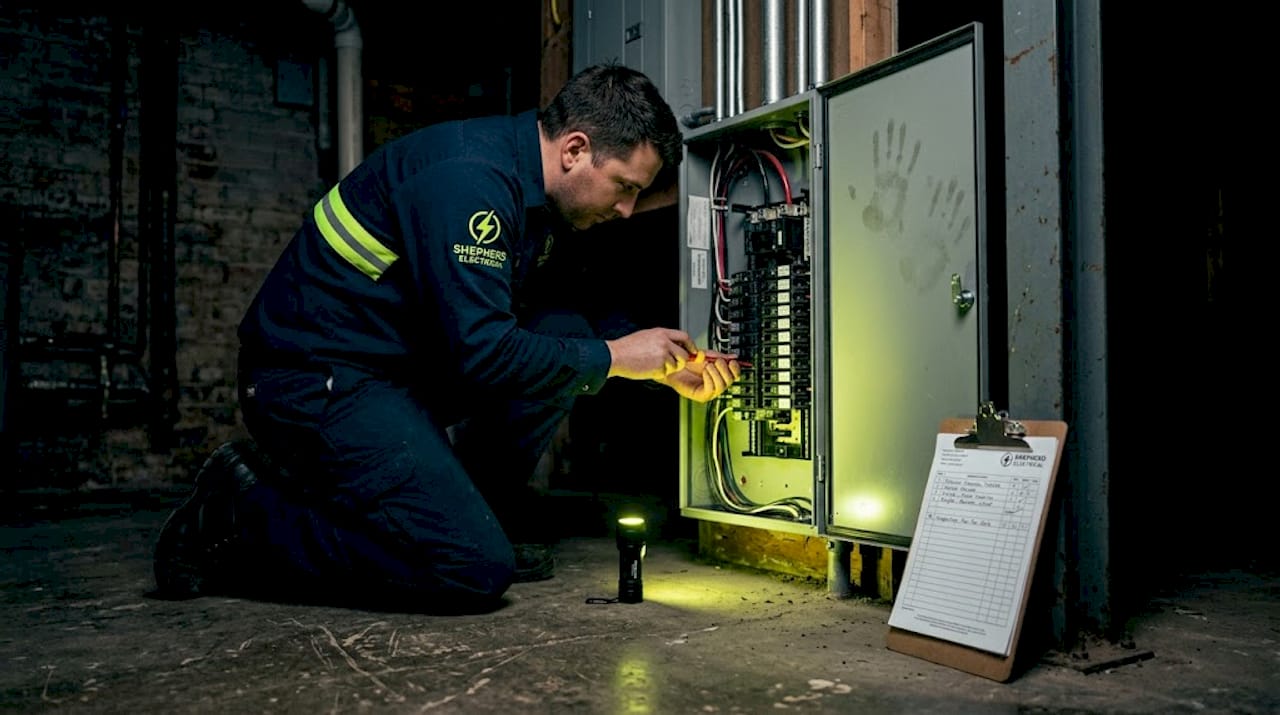
Circuit breaker nuisance tripping is another frequent complaint. Before replacing a breaker, check whether the circuit is genuinely overloaded, whether harmonics from variable frequency drives or uninterruptible power supplies are affecting the breaker’s thermal element, or whether the breaker itself is aging. Preventive maintenance tasks like breaker testing will catch units that no longer trip within their rated time-current curve, which is a safety failure waiting to happen.
Emergency lighting failures often appear only when they matter most. A light that passes the monthly 30-second test can still fail the annual 90-minute discharge test if the battery has degraded below capacity. Monthly tests alone can create false confidence. Replace batteries on a scheduled basis, not just when they fail a test.
“In regulator eyes, if it wasn’t documented, it wasn’t done. Every inspection, every test result, every corrective action needs a date, a name, and a result — full stop.” — NFPA 70B compliance guidance
Managing arc-flash hazards during maintenance requires more than PPE in a cabinet. Your team needs site-specific arc-flash labels on all equipment, an updated single-line diagram, and clear written procedures. If any of those three elements are missing or outdated, stop work and get them corrected first. It is not worth the risk.
Pro Tip: Keep your electrical system assessments and single-line diagrams in a shared digital location that your maintenance team and any outside contractors can access before starting work. Outdated drawings are one of the most common root causes of electrical incidents.
Review your low-voltage safety practices alongside your high-voltage procedures. Low-voltage systems including communications, security, and building controls carry their own risk profile that often gets overlooked in standard electrical maintenance programs.
Verifying and documenting your maintenance program
Running maintenance tasks is half the job. Proving you ran them is the other half. Documentation gaps are treated as compliance failures by OSHA and insurers. Records must show who performed the work, what was inspected or tested, when it was done, what the results were, and what corrective action was taken when deficiencies appeared.
Here is how to structure a documentation process that will hold up under scrutiny:
- Create a master log for each piece of equipment. Every inspection entry goes in chronological order with technician name, date, and findings.
- Log test results numerically, not just pass/fail. Insulation resistance values, breaker trip times, and thermography temperature readings all tell a more complete story over time.
- Record corrective actions with timelines. If a deficiency is found, document when the repair was scheduled, who performed it, and what the verification result was.
- Retain records for the life of the equipment at minimum. Many insurers and OSHA inspectors want to see historical trends, not just the last inspection.
- Conduct an internal program audit annually. Assign someone to review whether all scheduled tasks were completed, whether records are complete, and whether the EMP itself needs updating based on equipment changes or new standards.
| Documentation element | Why it matters |
|---|---|
| Technician name and credentials | Proves qualified personnel performed the work |
| Numerical test results | Enables trend analysis and early fault detection |
| Deficiency records and repair dates | Demonstrates due diligence to OSHA and insurers |
| Equipment modification history | Keeps single-line diagrams and arc-flash studies current |
Your maintenance records also feed directly into capital planning. Trending data on insulation resistance, transformer temperature, and breaker performance tells you which equipment is approaching end of life. That kind of foresight lets you budget for replacements before an emergency forces your hand. Routine maintenance programs reduce downtime and extend asset life. The documentation is what makes that benefit visible to ownership and insurers alike.
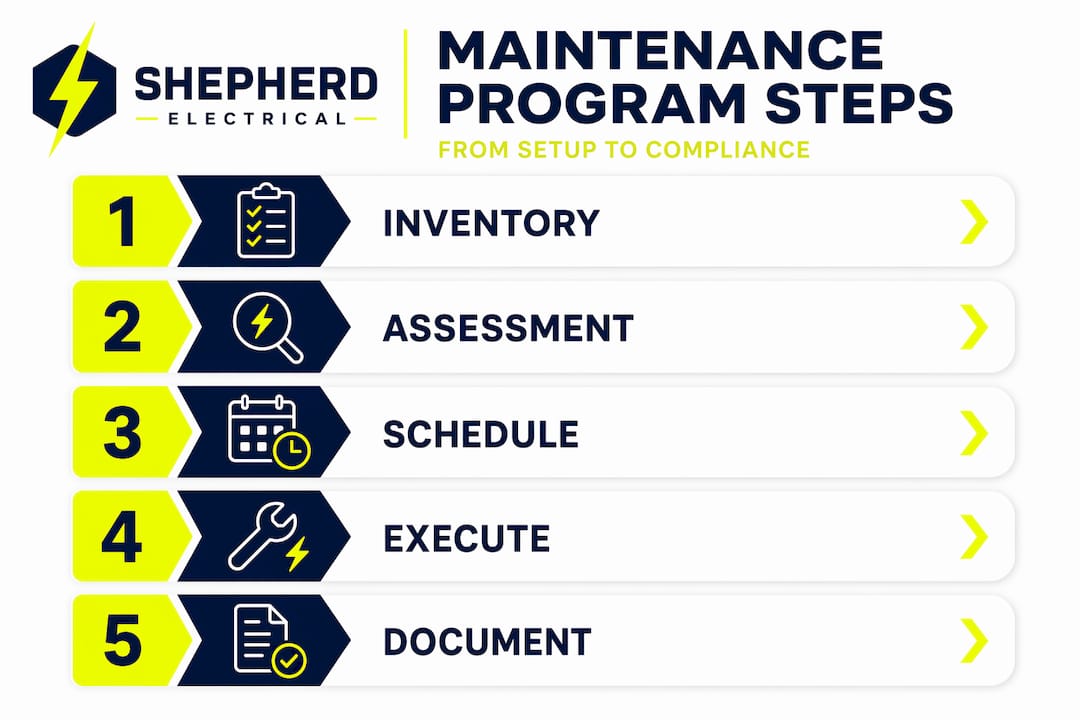
Review your network infrastructure maintenance protocols alongside your electrical records. Facilities that align both programs tend to perform better during third-party audits because the documentation culture is consistent across systems.
My take on why most programs fall short
I have worked on commercial electrical systems long enough to see the same failure pattern repeat itself. A facility gets cited, or worse, has an incident. They rush to put a maintenance program together. They schedule inspections, buy some PPE, and check a few boxes. Then twelve months later the program is already slipping because nobody owns it and the documentation is scattered across three spreadsheets and a filing cabinet nobody opens.
The real problem is not that property managers don’t care about electrical safety. They do. The problem is that preventive maintenance has moved from optional best practice to mandatory compliance expectation, and many facilities never got the memo. NFPA 70B becoming a mandatory referenced standard changed the game quietly, and a lot of managers are still operating like it’s an advisory document.
What I’ve found actually works is treating the EMP like a contract with yourself. Assign a single person as program owner. Build the schedule into your facility management software, not a standalone spreadsheet. And bring in a qualified electrical contractor at least once a year to perform tasks that genuinely require specialized equipment and credentials. Infrared thermography, breaker testing, and arc-flash studies are not DIY work. Trying to handle them in-house without the right tools and training creates liability instead of reducing it.
The facilities that consistently pass audits and avoid costly failures share one trait. Their documentation is as tight as their maintenance. Every record is dated, named, and filed. That discipline is what separates a program that protects you from one that just looks good on paper.
— Brad
How Shepherdelectricalconstruction can support your maintenance program

If you are a property manager or business owner in the Edmond or Oklahoma City Metro area, Shepherdelectricalconstruction brings the qualified personnel, specialized tools, and code knowledge your maintenance program requires. From NFPA 70B-aligned inspection schedules and infrared thermography to emergency lighting testing and arc-flash assessments, the team handles the work that demands real credentials. Understanding what electrical contractors do in a commercial maintenance context helps you build a stronger, more defensible program. You can also explore the full electrical services overview to see where Shepherdelectricalconstruction fits into your compliance plan. Contact the team today to schedule a consultation.
FAQ
What is required in a commercial electrical maintenance program?
A written Electrical Maintenance Program under NFPA 70B must include an equipment inventory, scheduled inspection and testing intervals, qualified personnel requirements, and documented records of all findings and corrective actions.
How often should commercial electrical systems be inspected?
Most major equipment requires annual inspection and testing, with monthly visual checks and emergency lighting tests required under NFPA 101. High-criticality equipment may warrant more frequent attention based on risk assessment.
What does NFPA 70E require for commercial electrical maintenance?
NFPA 70E requires arc-flash risk assessments before any energized work, proper PPE selection, and an Energized Electrical Work Permit for tasks within the restricted approach boundary. Work exceeding 40 cal/cm² incident energy is prohibited.
Why does documentation matter for electrical compliance?
OSHA and insurance auditors treat missing records as missing maintenance. Complete documentation showing who, what, when, results, and corrective actions is your primary defense during inspections and liability reviews.
What is the annual emergency lighting test requirement?
NFPA 101 requires a 90-minute full discharge test annually in addition to monthly 30-second functional tests. The annual test verifies that batteries can sustain emergency lighting for a full evacuation scenario.