

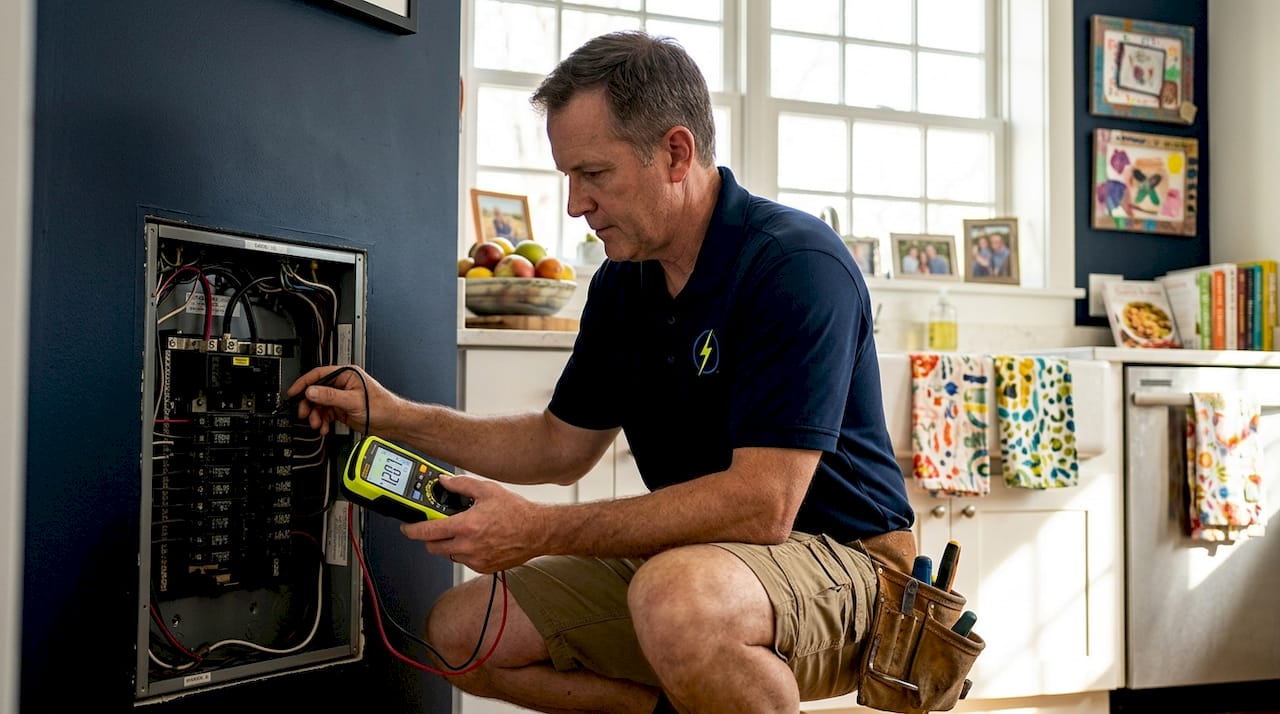
Most people treat electrical problems like a minor inconvenience, flip the breaker, move on, and hope nothing burns down. That mindset is exactly why understanding why electrical troubleshooting matters is so urgent for homeowners and small business owners in Edmond and the Oklahoma City Metro area. Electrical faults do not resolve themselves. They hide inside walls, grow worse under load, and occasionally end in fires, shocks, or far worse. The good news is that systematic troubleshooting catches problems before they escalate, and this article walks you through what that looks like in practice.
Table of Contents
- Why electrical troubleshooting matters: Understanding the real risks
- The role of systematic electrical troubleshooting in safety and efficiency
- Common residential and small business electrical problems and how troubleshooting prevents hazards
- Advanced troubleshooting techniques every homeowner and small business owner should know
- Practical tips for applying troubleshooting to improve your home or small business electrical safety
- Why disciplined electrical troubleshooting is your home’s and business’s best safeguard
- How Shepherd Electrical supports safe and efficient electrical troubleshooting in Edmond and OKC
- Frequently asked questions
Key Takeaways
| Point | Details |
|---|---|
| Electrical hazards risk lives | Electrical faults commonly cause injuries and costly fires, making troubleshooting essential to safety. |
| Systematic troubleshooting saves time | Following a structured step-by-step approach reduces misdiagnosis and shortens repair time. |
| Common faults have hidden signs | Intermittent problems often indicate dangerous issues like loose connections that require precise testing. |
| Safety starts with proper procedures | Always verify circuits are de-energized and follow lockout/tagout safety protocols during troubleshooting. |
| Professional help prevents hazards | Complex or persistent electrical problems should be handled by licensed electricians for safety and compliance. |
Why electrical troubleshooting matters: Understanding the real risks
Before you can appreciate the importance of electrical troubleshooting, you need a clear picture of what bad electrical systems actually do to homes and businesses. The numbers are not abstract.
Workplace electrical injuries tell a blunt story: contact with electric current causes an average of 126 fatal workplace injuries every year in the US, alongside more than 2,200 non-fatal electrical injuries annually. Those numbers skew toward commercial settings, but residential environments carry their own serious risk. Electrical fires cause $1.4 billion in property damage every year in American homes, with overloaded circuits responsible for initiating roughly 14% of those fires.
Here in Oklahoma, older housing stock and aging commercial wiring in the OKC Metro area add another layer of exposure. What often looks like a minor issue, a breaker that trips occasionally or an outlet that runs warm, is usually a symptom of something deeper. Missing that symptom is where the real danger lives.
Common electrical hazards that proper troubleshooting catches early:
- Overloaded circuits from adding appliances to circuits not rated for the demand
- Arcing faults inside junction boxes or behind outlets caused by loose or damaged wiring
- Backstab outlet connections that work fine initially but loosen under heat cycling
- Deteriorated insulation on older wiring that creates ground fault and fire risk
- GFCI protection that has failed silently and is no longer protecting occupants
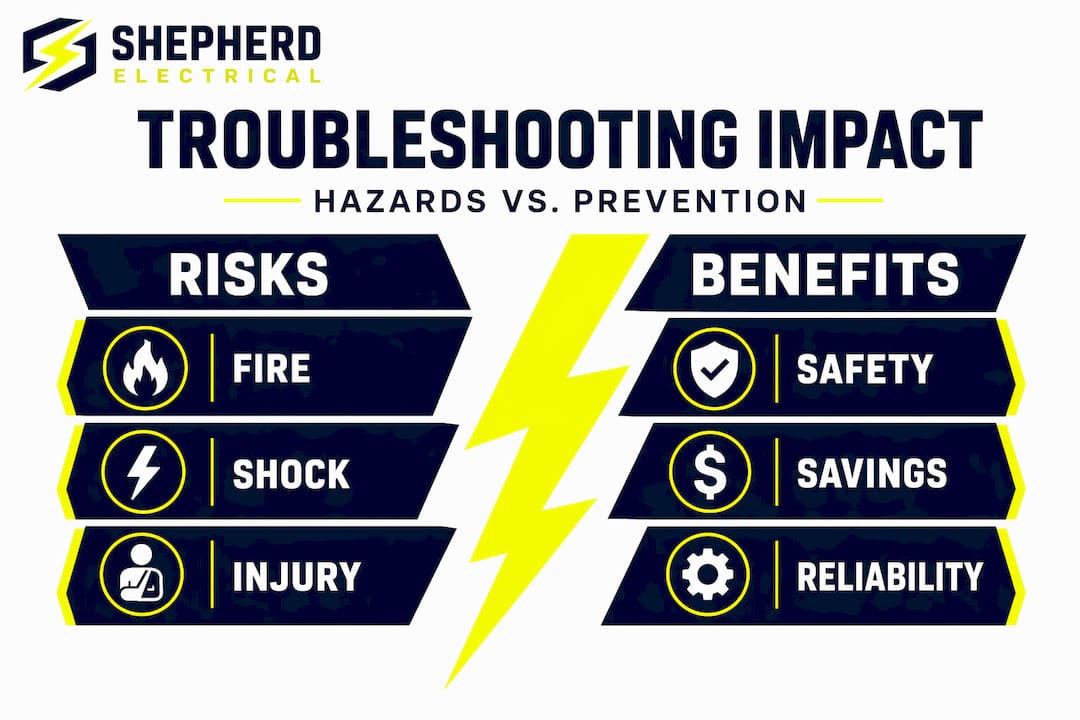
Understanding these risks makes the benefits of troubleshooting concrete: catching a loose connection or a silently failed GFCI is not a maintenance task, it is a life-safety action. Our guide to electrical maintenance tips covers the habits that keep these hazards from taking hold.
The role of systematic electrical troubleshooting in safety and efficiency
Troubleshooting is not the same as guessing. Random part replacement is guessing with a tool belt on. Actual troubleshooting follows a defined method, and that distinction matters enormously when you are working near energized circuits.
Systematic troubleshooting reduces diagnostic time by up to 70% and eliminates misdiagnosis on 120V and higher circuits, directly preventing shocks and fires. Live-dead-live voltmeter verification, mandated by OSHA, is one example of why the process matters more than the tools. You test your meter on a known live source, verify the suspect circuit reads dead, then confirm your meter still works on the live source again. Skip that middle step and you might open a live panel thinking the power is off.
The five-step troubleshooting process used by qualified electricians:
- Identify the symptom — What is the circuit doing or failing to do? Flickering, tripping, not powering?
- Gather information — When did it start? What changed? What loads are on that circuit?
- Isolate the fault — Narrow the problem to a specific circuit, device, or component.
- Test the component — Use proper instruments to verify voltage, continuity, or insulation integrity.
- Repair and verify — Fix the root cause, not just the symptom, then confirm the repair holds.
Pro Tip: Never skip the verification step after a repair. Many electricians have fixed one fault only to discover a second one that was hidden by the first. Testing the circuit after repair confirms you got everything, not just the obvious issue.
This structured approach is exactly what separates a $150 repair from a $4,000 rewire job that resulted from guesswork. Our home electrical inspection guide explains what a professional inspection covers and when to schedule one.
Common residential and small business electrical problems and how troubleshooting prevents hazards
Some electrical problems show up constantly in Edmond homes and OKC Metro commercial spaces. Knowing what they look like, and what drives them, gives you the context to take them seriously.
GFCIs introduced a 95% drop in electrocutions, but here is the catch: faulty GFCIs fail silently. They look fine, but they have stopped protecting you. Monthly testing is the only way to know whether your GFCI is actually functioning. Press the test button, confirm the outlet goes dead, press reset, confirm power returns. It takes 20 seconds and it is non-negotiable.
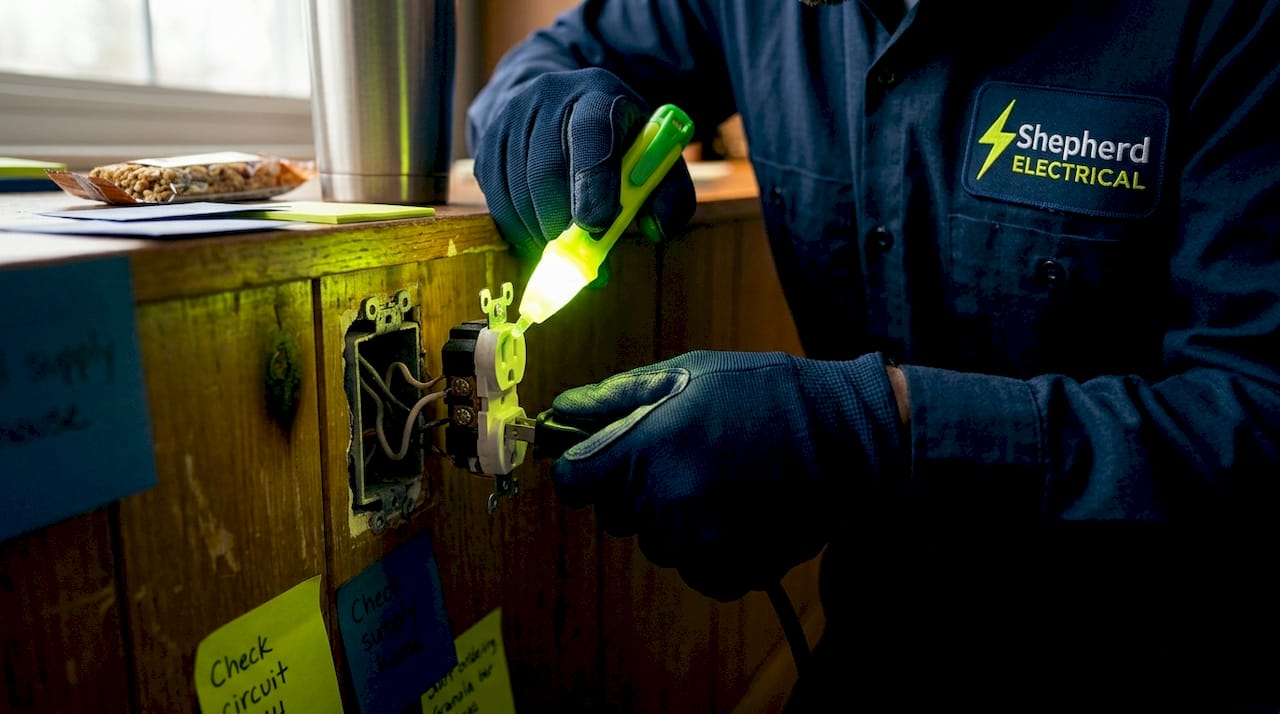
Loose backstab connections on outlets are another persistent hazard. These are the cheap push-in terminals on the back of standard receptacles. They expand and contract with heat, gradually loosen, and eventually arc. A receptacle tester identifies failed connections before they cause real damage. This is not a dramatic failure mode, which is exactly why it gets overlooked until something burns.
| Problem | Root cause | Symptom | Troubleshooting action |
|---|---|---|---|
| Tripped breaker | Overload or short circuit | Circuit dead, breaker in middle position | Reduce load, test each device, reset once |
| GFCI not protecting | Failed GFCI unit | No trip on test button press | Replace GFCI receptacle immediately |
| Flickering lights | Loose connection or bad dimmer | Intermittent dimming or flicker | Check connections, test under load |
| Warm outlet or switch | Backstab connection, overload | Heat from faceplate, discoloration | Replace with screw-terminal device |
| Breaker that will not hold | Short circuit or ground fault | Breaker trips immediately on reset | Professional diagnosis required |
Signs that a common problem has a deeper root cause:
- A breaker that trips repeatedly under normal load (not just when you overload it)
- An outlet that sparks or shows scorch marks around the face
- A circuit that loses power intermittently without any clear cause
- Burning or plastic smell near your panel or any outlet
Our guide to residential electrical maintenance covers how to address many of these before they require emergency repairs.
Advanced troubleshooting techniques every homeowner and small business owner should know
Most homeowners are comfortable resetting a breaker. Fewer understand what to do when the breaker trips again five minutes later. That gap in knowledge is where electrical problems escalate.
Many intermittent faults are thermal, meaning they only appear when the circuit is under load and components have warmed up. A simple voltage check on a cold, unloaded circuit will show nothing. You have to test under actual operating conditions to catch these. That is why a qualified electrician does not just check your panel, they run loads and observe behavior over time.
Skipping steps in the five-step process increases misdiagnosis risk on 120V circuits significantly. This is not a technicality. Misdiagnosis on a live residential circuit means you are touching something you believe is safe that is not. The consequence is a shock, a burn, or worse.
Advanced tools and techniques worth understanding:
- Insulation resistance testers (megohmeters) measure how well a wire’s insulation is holding up. Degraded insulation reads lower resistance and signals fire or shock risk before any visible damage appears.
- Clamp meters measure current draw on a circuit without breaking the circuit, helping identify overloads and phantom loads.
- Thermal imaging detects hot spots inside walls and panels that indicate arcing or high-resistance connections invisible to the eye.
- Load testing intentionally stresses a circuit to reproduce intermittent faults that hide at idle.
Pro Tip: If an electrician diagnoses your problem without running the circuit under load, ask why. Thermal faults that only appear under real operating conditions are missed by quick cold checks. A thorough diagnosis takes the circuit through its actual duty cycle.
Our electrical system assessment guide explains what a full assessment involves and why it is worth scheduling before problems appear.
Practical tips for applying troubleshooting to improve your home or small business electrical safety
Knowing why electrical repair is essential is one thing. Acting on it is another. Here is what responsible electrical safety practice looks like in everyday terms for Edmond homeowners and OKC Metro business owners.
70% of workplace electrical fatalities occur among workers in non-electrical occupations, largely because of skipped precautions like de-energizing circuits and using lockout/tagout procedures. That translates directly to homeowners and small business owners who attempt repairs without verifying the circuit is truly off.
Six practical steps to safer electrical troubleshooting at home or work:
- Always verify power is off with a tested voltmeter before touching any wiring. Do not assume a flipped breaker means a circuit is dead.
- Use lockout/tagout procedures when working on panels or breakers, even briefly. This means physically preventing the breaker from being switched back on while you work.
- Test GFCIs monthly, every month, without exception. Write it on your calendar if needed.
- Note every time a breaker trips. One trip might be a fluke. Two or more on the same circuit means something needs diagnosis.
- Call a licensed electrician when you smell burning, see discoloration near outlets, or experience flickering that does not resolve after checking connections.
- Schedule a professional electrical inspection every few years, or before purchasing or renovating a property.
Pro Tip: Your nose is one of the best diagnostic tools you have. A faint burning plastic smell that comes and goes is a serious warning sign of arcing inside a wall or box. Do not ignore it and assume it will resolve. That smell is a fire looking for oxygen.
Our professional electrical services page outlines when professional intervention is the right call and what you can expect from a qualified electrician.
Why disciplined electrical troubleshooting is your home’s and business’s best safeguard
Here is something most electrical articles will not tell you: the biggest risk in residential electrical safety is not bad wiring. It is casual attitude.
People reset breakers without investigating why they tripped. They ignore outlets that feel warm. They live with flickering lights for months because “it’s probably nothing.” That casual attitude is the real hazard. The wiring is fixable. Complacency is harder to address.
Electricity kills. The Bureau of Labor Statistics confirms an average of 126 fatal workplace electrical injuries annually. Those deaths are not random. They follow a pattern: someone was working near electricity without proper precautions, without verified de-energization, and without a systematic approach to what they were doing.
The solution is not fear. It is discipline. A culture of disciplined electrical problem-solving in your home or business means treating any unusual electrical behavior as a signal worth investigating, not dismissing. It means testing GFCIs instead of assuming they work. It means calling a licensed electrician when the problem exceeds your training, not after it gets worse.
This is also where regular professional collaboration pays off. A qualified electrician who knows your panel, your load history, and your building’s quirks can catch developing problems years before they become emergencies. Understanding electrical panel hazards is one place to start that education.
Troubleshooting is not just a technical skill. It is the practice of taking your electrical system seriously enough to look closely at it. That practice, applied consistently, is what separates the homes and businesses that have electrical emergencies from the ones that do not.
How Shepherd Electrical supports safe and efficient electrical troubleshooting in Edmond and OKC
When your electrical system gives you trouble, having the right team behind you changes everything.

Shepherd Electrical provides licensed, code-compliant troubleshooting and repair services for homeowners and small businesses throughout Edmond and the Oklahoma City Metro area. Our team follows OSHA and NEC standards on every job, which means systematic diagnosis, proper de-energization, and verified repairs rather than quick guesses that leave problems unresolved. Whether you are dealing with a tripping breaker, a failed GFCI, or something more complex inside your panel, we have the tools and training to find the root cause the first time. Learn more about what electrical contractors do and why it matters, explore our local service area and team, or review our full range of electrical services. Book online or call us directly to schedule a diagnostic visit.
Frequently asked questions
What is electrical troubleshooting and why is it important?
Electrical troubleshooting is the systematic process of identifying and fixing faults in electrical systems to ensure safety and prevent hazards like fires and shocks. Without it, underlying problems go undetected until they cause serious damage or injury.
How often should homeowners test their GFCIs?
Homeowners should test GFCIs every month, since faulty units fail silently and stop protecting you without any visible warning. The test takes less than a minute and could prevent a fatal shock.
When should I call a professional electrician for troubleshooting?
Call a licensed electrician if you experience repeated breaker trips, burning smells, discoloration near outlets, or any issue that involves your main panel. These are not situations where guessing is acceptable.
Can I perform electrical troubleshooting safely without professional training?
Basic tasks like resetting a breaker or testing a GFCI are within most homeowners’ abilities, but complex electrical work involving panels, wiring, or anything requiring opening an energized box should always involve a licensed electrician.
What tools are essential for electrical troubleshooting?
The core kit includes a digital multimeter, non-contact voltage tester, receptacle tester, and clamp meter, and everything should be rated CAT III or IV for safety on residential circuits. A cheap, unrated tester is not a safe substitute.
Need help with this at your home?
Shepherd Electrical helps Edmond and OKC metro homeowners with troubleshooting, repairs, GFCIs, outlets, and safety inspections. Free estimates are available, and workmanship is backed by a lifetime guarantee.