
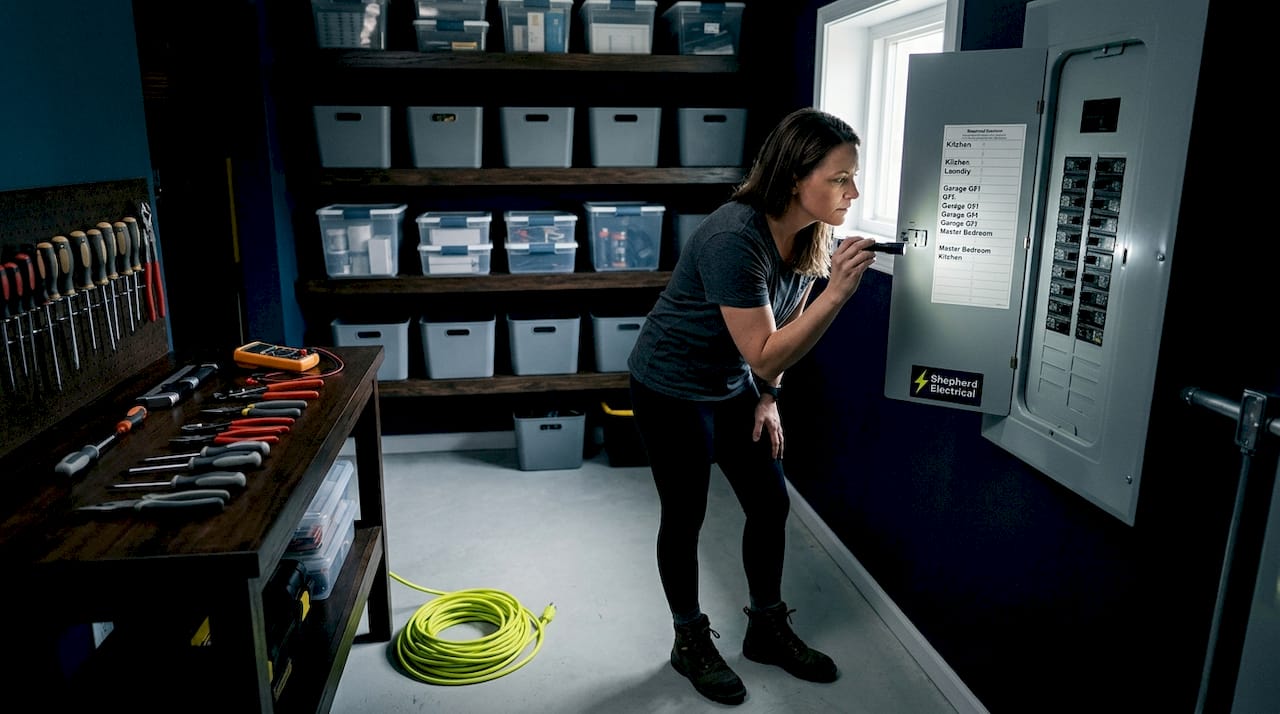
Choosing the right electrical system for your Edmond or Oklahoma City Metro home goes far beyond making sure the lights come on. Your electrical system controls safety, energy efficiency, insurance coverage, and whether your home can handle modern upgrades like EV chargers or solar panels. Get it wrong, and you’re looking at fire hazards, code violations, and costly rework. This guide walks you through every major piece of residential electrical systems so you can make smarter decisions about repairs, upgrades, and long-term home safety.
Table of Contents
- What defines a home electrical system?
- Main types by voltage and configuration
- Wiring methods and cable types in Edmond/OKC homes
- Panels, subpanels, and ampacity: why size and layout matter
- Modern safety features: AFCI, GFCI, and more
- Expert take: System upgrades require a holistic approach
- Get trusted help with your Edmond/OKC electrical system
- Frequently asked questions
Key Takeaways
| Point | Details |
|---|---|
| System scope | A home electrical system includes everything from the utility connection to outlets and appliances. |
| Wiring types | Common wires include NM (Romex), UF, BX, and some old homes may have knob-and-tube. |
| Panels and capacity | Panels are rated in amps—main and subpanels must match your electrical needs for upgrades. |
| Safety devices | Modern codes require AFCI and GFCI protection to prevent fire and shock hazards. |
| Professional upgrades | Safe upgrades depend on matching panel, wiring, and protection with professional help. |
What defines a home electrical system?
Most homeowners picture their electrical system as outlets, switches, and a breaker box. But the real picture is larger. US residential electrical systems are described as a distribution chain that starts at the utility connection and flows through the meter and main panel out to every branch circuit in your home. Each link in that chain plays a specific role.
Here are the main components you’ll encounter:
- Service entrance: The point where utility power enters your home, typically through overhead wires or underground cables
- Meter: Installed by the utility company, this measures your total electricity consumption
- Main panel (load center): The hub that receives power from the meter and distributes it through individual breakers
- Branch circuits: Individual circuits feeding specific areas or appliances, each protected by its own breaker
- Outlets, switches, and fixtures: The visible endpoints where you actually use electricity
- Major appliances: High-draw loads like HVAC units, water heaters, and ranges that often have dedicated circuits
“Understanding your home’s electrical system isn’t just for electricians. It’s essential knowledge for any homeowner making upgrade or repair decisions.” The more you know about each component, the better you can communicate with a contractor and catch potential problems early.
The National Electrical Code (NEC) sets the national safety and compliance standard for all residential electrical work. Most local jurisdictions in Oklahoma, including Edmond and OKC, adopt the NEC and may add local amendments. Knowing this matters because any permitted electrical work must pass inspection against these standards. Insurance companies also look at NEC compliance when evaluating risk. An outdated or non-compliant system can complicate claims or even void coverage after an incident.
Main types by voltage and configuration
Voltage configuration is the primary way home electrical systems are categorized. Most Oklahoma homeowners have one type, but understanding the differences helps if you’re planning major upgrades.
120/240V single-phase split service is the residential standard across the US, including all of Edmond and OKC. Your utility delivers two 120V legs and a neutral. Together, those legs give you 240V for large appliances like dryers and central air conditioners. Separately, each leg powers the 120V outlets throughout your home. This configuration handles virtually every residential need.
Three-phase power is rare in residential settings. You might find it in homes with large workshops, high-end home theaters with commercial-grade equipment, or properties that were previously commercial. Three-phase delivers more consistent power for heavy industrial-style motors but comes at a higher installation cost and is simply unnecessary for the vast majority of Oklahoma homeowners.
Here’s a quick comparison:
| Feature | 120/240V Single-Phase | Three-Phase |
|---|---|---|
| Typical use | All residential homes | Industrial/workshop only |
| Common in OKC/Edmond | Yes | Rarely |
| Powers standard appliances | Yes | Yes, but oversized |
| Installation cost | Standard | Significantly higher |
| Utility availability | Widely available | Limited residential access |
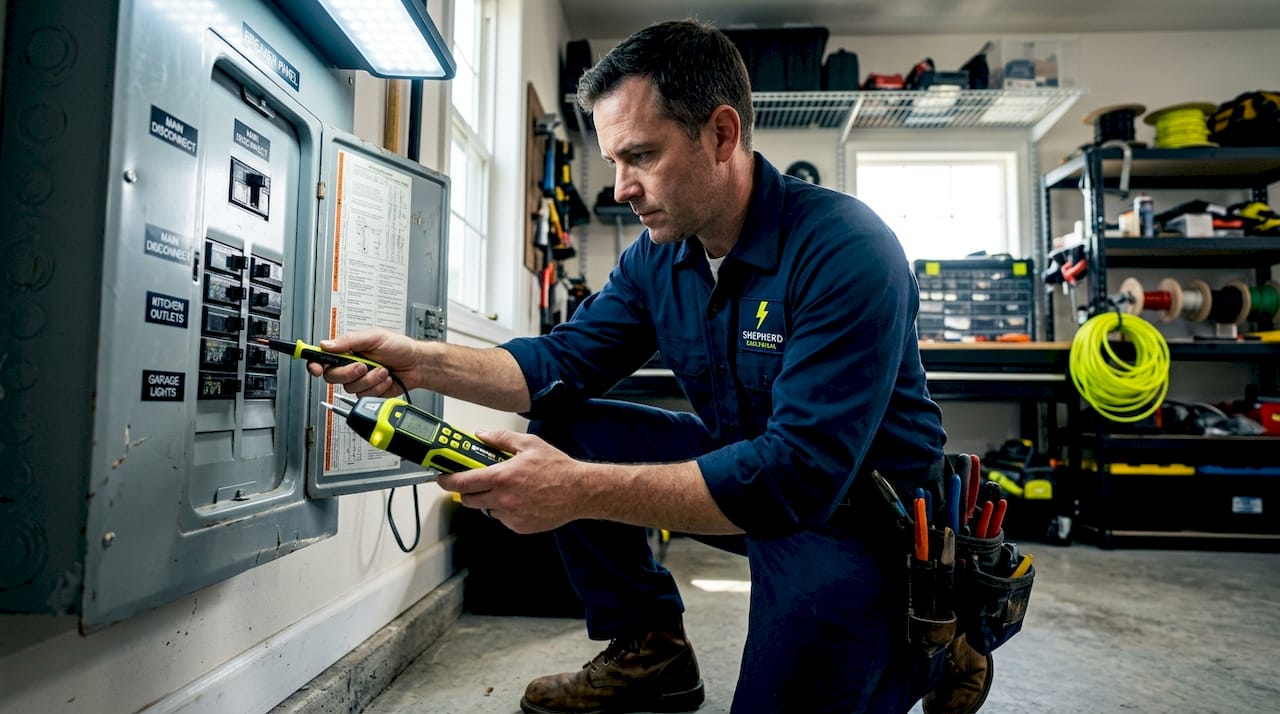
To identify what your home has, check the top of your main panel. Single-phase systems have two main breaker handles side by side. Three-phase systems have three. Your utility bill or a call to your utility company can confirm your service type as well.
Panel safety and compliance is closely tied to your service configuration. If you’re unsure what service your home uses, a licensed electrician can identify it quickly during any inspection or upgrade visit.
Wiring methods and cable types in Edmond/OKC homes
The wiring inside your walls is just as important as the panel that feeds it. Residential branch circuits commonly use NM cable (also called Romex), but older homes and special locations use other methods. Here’s what you’re likely to find in Edmond and OKC homes depending on their age.
| Wiring type | Common era | Where used | Notes |
|---|---|---|---|
| Knob-and-tube | Pre-1950s | Older neighborhoods | No ground wire, often brittle |
| Aluminum branch wiring | 1960s-1970s | Some mid-century homes | Fire risk at connections |
| NM cable (Romex) | 1970s-present | Most modern homes | Most common choice today |
| UF cable | Any era | Underground, wet areas | Burial-rated for outdoor runs |
| BX (armored cable) | 1940s-present | Garages, industrial areas | Metal-sheathed protection |
| THHN/THWN in conduit | Any era | Exposed runs, garages | Most durable, code-preferred in conduit |
What older Edmond and OKC homes are likely to have:
- Homes built before 1960 may still have knob-and-tube wiring in attics or walls
- Homes built during the 1960s and 1970s sometimes have aluminum wiring on 15 and 20 amp branch circuits, which creates connection problems over time
- Most homes built after 1980 use copper NM cable throughout
Why wiring type matters for upgrades:
Outdated wiring affects more than safety. Many insurance companies charge higher premiums or refuse to insure homes with knob-and-tube wiring. If you’re adding efficient wiring upgrades, the existing wiring condition directly affects how much additional work is needed. You can’t simply add a new circuit to a panel if the wiring feeding that area is undersized, degraded, or the wrong type for the application.
Pro Tip: If you’re buying a home built before 1975 in the Edmond or OKC area, ask your inspector specifically about aluminum branch circuit wiring and knob-and-tube in the attic. Both require attention before most insurers will provide standard coverage.
UF cable is worth a specific mention for Oklahoma homes because of how many homeowners want to add outdoor lighting, workshop power in detached garages, or irrigation control. UF (Underground Feeder) cable is rated for direct burial and handles the temperature swings Oklahoma is famous for far better than standard NM cable run through PVC conduit alone.
Panels, subpanels, and ampacity: why size and layout matter
Your main electrical panel is the distribution center for everything in your home. Home electrical panels are classified primarily by their ampacity rating and whether they include a main disconnect. Here’s what those numbers actually mean for you.
Common panel sizes and what they support:
- 100-amp panels: Found in older homes, typically adequate for homes under 1,200 square feet with no major electric appliances. Often insufficient today.
- 150-amp panels: A middle-ground option, suitable for average-sized homes without high-draw upgrades
- 200-amp panels: The current standard for new construction and most upgrades. Necessary if you want EV charging, solar integration, or electric HVAC
Subpanels are secondary distribution points fed from the main panel. Common uses include:
- Detached garages or workshops needing their own circuit group
- Home additions where running individual circuits back to the main panel isn’t practical
- Distributing power from solar systems or generators
One critical rule for subpanels: the neutral bar and ground bar must be kept separate, unlike in the main panel where they bond together. Getting this wrong creates dangerous current paths and will fail inspection every time.
Signs your panel needs upgrading:
- Your home still has a fuse box instead of circuit breakers
- Breakers frequently trip under normal load
- You have a Federal Pacific or Zinsco panel (known safety concerns)
- You want to add an EV charger, hot tub, or solar system
- You’re running extension cords regularly because outlets aren’t sufficient
Pro Tip: Before calling for an upgrade, count the open breaker slots in your panel. If you have fewer than two open slots, you’ll likely need either a panel upgrade or a subpanel to accommodate new circuits.
Warning signs for panel replacement are worth understanding before you schedule any high-draw upgrade. And when you’re ready to move forward, the step-by-step upgrade process makes the project less intimidating.
Modern safety features: AFCI, GFCI, and more
This section is where many homeowners have the biggest knowledge gap, and it’s also where some of the most important safety improvements happen. Modern electrical codes require enhanced fault protection for residential systems, specifically AFCI for arc-fault detection and GFCI for ground-fault protection.
AFCI (Arc-Fault Circuit Interrupter) breakers detect dangerous electrical arcing, the kind that happens inside walls when wiring is damaged, pinched, or deteriorated. Arcing is one of the leading causes of residential electrical fires, and a standard breaker won’t catch it before damage is done. Current NEC requirements mandate AFCI protection in bedrooms, living rooms, dining rooms, hallways, and most other finished areas.
GFCI (Ground-Fault Circuit Interrupter) devices detect tiny current imbalances that indicate electricity is taking an unintended path, possibly through a person. GFCIs must be installed in:
- Kitchens (within six feet of any sink)
- Bathrooms (all outlets)
- Garages and unfinished basements
- Outdoor outlets
- Crawl spaces and near pools or spas
“A GFCI can detect a current imbalance as small as 4 to 6 milliamps and respond in as little as 1/40th of a second. That speed is what makes it life-saving in wet areas.”
What Edmond and OKC upgrades must address:
When you pull a permit for electrical work in this area, inspectors will verify that new work meets current NEC requirements. That often means AFCI breakers for any bedroom circuits you touch and GFCI outlets in any wet area you modify. Older outlets in these areas may have been grandfathered in, but once you open a permit, current code applies to the scope of work.
Whole-home surge protection is an increasingly popular addition during panel upgrades. Oklahoma’s severe weather and lightning activity make power surges a real threat. A whole-home surge protector installs at the panel and shields every circuit simultaneously. It’s far more effective than individual plug-in surge strips, which only protect the devices connected to them.
Explore the best electrical upgrades for Edmond and OKC homes to see where AFCI, GFCI, and surge protection rank alongside other improvements. For any upgrade requiring permits, Oklahoma electrical permits and compliance covers what you need to know before work begins.
Expert take: System upgrades require a holistic approach
Here’s something we see constantly in the field: homeowners focus all their energy on one component. They want a bigger panel, or they want an EV charger, or they want to rewire one room. That single-focus approach leads to expensive surprises.
The system-type decision is rarely just about panel size. We’ve visited homes where the owner installed a brand-new 200-amp panel but left 1970s aluminum wiring on the branch circuits. The panel upgrade was correct. But the aluminum wiring at the outlets and switches created connection problems that the bigger panel couldn’t fix. Safety requires matching every layer of the system, not just upgrading one piece.
The same logic applies to modern loads. EV chargers and high-draw equipment require not just breaker space but adequate wire gauge from the panel to the charger location, proper AFCI or GFCI protection depending on install location, and a permit with inspection. We’ve seen homeowners install a Level 2 charger without a permit, only to discover during a home sale that the installation doesn’t comply with code. That creates real problems at closing.
Our strong recommendation: before any major upgrade, get a professional assessment of the full system. That means the service entrance condition, panel ampacity and breaker inventory, wiring type and condition throughout the home, and existing protection devices. An inspection and compliance checklist gives you a structured way to approach that assessment. It’s far cheaper to catch mismatches before the work starts than after the permit fails inspection.
Get trusted help with your Edmond/OKC electrical system
Understanding your system is the first step. Acting on that knowledge safely is the next one. Whether you’re planning a panel upgrade, adding circuits for an EV charger, replacing outdated wiring, or simply making sure your home’s protection devices are up to code, professional help makes the difference between a compliant installation and a costly redo.
At Shepherd Electrical, our residential electrician services cover everything from full system assessments to targeted upgrades and emergency repairs across Edmond and the OKC Metro. We handle permitting, inspection coordination, and code compliance so you don’t have to figure that out on your own. If you’re ready to make your home safer and more efficient, reach out for a qualified assessment. Our team can identify exactly where your system stands today and what it needs to meet your goals. Explore how safer home wiring fits into a full upgrade plan for your property.
Frequently asked questions
Do I need a permit for electrical work in Oklahoma City or Edmond?
Yes, most electrical upgrades require a permit. Panel upgrades, new circuits, and rewiring all require permits in Oklahoma City; like-for-like device replacements at the same location are generally permit-free.
How do I know if my wiring is outdated?
Check for ungrounded two-prong outlets, flickering lights, or visible old wiring in the attic. Knob-and-tube wiring and aluminum branch circuits are clear signals that a professional inspection is overdue.
What’s the difference between AFCI and GFCI protection?
AFCIs detect dangerous arcing that can start fires inside walls, while GFCIs detect current imbalances to prevent electrocution. AFCI protects against fire hazards in living areas; GFCI protects against shock in wet locations like kitchens and bathrooms.
Can I add an EV charger or solar panels to my existing panel?
Only if your panel has sufficient ampacity and open breaker space. Panel capacity for EV charging must be evaluated professionally before installation to avoid safety and code issues.
Who should perform electrical upgrades in my home?
A licensed electrician should handle all upgrades to ensure safety, code compliance, and proper permitting. DIY electrical work that bypasses permits creates liability issues and can be flagged during home sales or insurance claims.
Recommended
- Electrical system assessment for safer homes: 2026 guide
- Electrical code compliance: Safety and efficiency guide
- Professional electrical services: boost home safety and value
- Upgrade Your Home Wiring for Safety and Efficiency
Need help with this at your home?
Shepherd Electrical helps Edmond and OKC metro homeowners with residential electrical service, repairs, upgrades, panels, EV chargers, solar, and backup power. Free estimates are available, and workmanship is backed by a lifetime guarantee.