


Many property owners assume that flipping a breaker or switching off a light switch before work begins eliminates any real electrical danger. That assumption is wrong, and understanding what is OSHA electrical safety makes clear exactly why. The Occupational Safety and Health Administration sets specific, enforceable standards for how electrical work must be done, what training workers must have, and how equipment must be guarded. Whether you own a home in Edmond or manage a commercial building in Oklahoma City, these standards directly affect your compliance obligations and, more importantly, your safety.
Table of Contents
- Understanding OSHA’s main electrical safety standards
- Who needs electrical safety training and what it covers
- Common electrical hazards and OSHA violations in Oklahoma properties
- Arc flash risks and the role of PPE in electrical safety
- Practical steps Oklahoma property owners can take to ensure OSHA compliance
- Why most homeowners and businesses misunderstand OSHA electrical safety — and what really protects you
- How Shepherd Electrical can help keep your Oklahoma property OSHA compliant and safe
- Frequently asked questions
Key Takeaways
| Point | Details |
|---|---|
| OSHA electrical standards | OSHA’s 29 CFR 1910 Subpart S sets essential rules on electrical installation, guarding, and working clearances for safe environments. |
| Required training | All employees exposed to electrical hazards need specific OSHA training to recognize and safely manage electrical risks. |
| Common violations | Cramped working space and missing equipment guards are frequent issues causing OSHA violations and increasing hazards. |
| Arc flash protection | Arc flash hazards require strict lockout/tagout and use of arc-rated personal protective equipment to prevent injuries. |
| Owner responsibilities | Property owners must ensure proper maintenance, training, and labeling to comply with OSHA standards and protect property. |
Understanding OSHA’s main electrical safety standards
Now that you understand why OSHA electrical safety matters, let’s look at the specific standards that apply to your property.
The foundation of OSHA electrical safety rules for general industry sits in 29 CFR 1910 Subpart S, which requires safe installation and proper guarding of all electrical equipment operating at 50 volts or more. That voltage threshold is lower than most people expect. A standard residential outlet runs at 120 volts, which means virtually every electrical component in your home or business falls under these requirements.
One of the most specific OSHA electrical safety standards involves working space. OSHA 29 CFR 1910.303(g)(1) requires a minimum 3-foot clearance in front of electrical equipment operating at 600 volts or less. This is not a suggestion. That clearance allows technicians to work safely, avoid accidental contact with live parts, and exit quickly in an emergency. In commercial properties especially, storage piled in front of panels is one of the most cited violations inspectors find.
Common OSHA requirements for electrical equipment
- All equipment must be approved and listed by a recognized testing organization
- Guards must be in place to prevent accidental contact with live parts
- All electrical installations must be installed in a neat, workmanlike manner
- Equipment operating at 50 volts or above must be protected from physical damage
- Panels and disconnect switches must be clearly labeled with voltage ratings
| Requirement | OSHA standard | Common violation |
|---|---|---|
| Working space clearance | 3 feet minimum | Storing boxes in front of panels |
| Equipment guarding | Required for 50 V and above | Missing knockouts in panel covers |
| Approved equipment | Must be listed/labeled | Unlisted extension cords as permanent wiring |
| Wiring integrity | No exposed conductors | Damaged insulation left unrepaired |
Pro Tip: Walk through your property and check every electrical panel for missing knockout covers or open slots. Those gaps expose live bus bars and are a quick way to fail an inspection. A good electrical system assessment can identify these issues before they become citations.
Who needs electrical safety training and what it covers
With a grasp on OSHA standards, the next step is understanding the training that ensures these rules are followed safely.
A common misconception is that only licensed electricians need electrical safety training. OSHA disagrees. All employees exposed to electrical hazards must receive training per OSHA 29 CFR 1910.332, including both qualified persons and workers who simply perform tasks near live parts. That includes your building maintenance staff, your janitor who replaces ceiling light bulbs, and contractors you hire for non-electrical work who might open a panel by mistake.
OSHA breaks training into two broad categories. Qualified workers receive in-depth training that covers identifying energized conductors, using voltage testing equipment, and applying lockout/tagout (LOTO) procedures. LOTO is the practice of physically locking a power source in the off position and tagging it to prevent accidental re-energization. Other affected workers receive general awareness training that teaches them to recognize hazards and know when to stay back.
What OSHA safety training must include:
- Recognition of electrical hazards specific to the worker’s tasks
- How to safely use extension cords, power tools, and portable equipment
- When and how to use personal protective equipment (PPE) like rubber gloves and face shields
- What to do when someone receives an electrical shock
- Understanding of lockout/tagout procedures and why unauthorized re-energization is dangerous
Retraining is required whenever tasks change, new equipment is introduced, or a worker shows signs of inadequate knowledge. This is not a one-and-done checkbox.
Pro Tip: When hiring any contractor for your Oklahoma home or business, ask directly whether their technicians have completed documented OSHA 1910.332 training. A qualified contractor will have this information ready. Learning about panel hazard awareness is a good way to know what questions to ask before work begins.
Common electrical hazards and OSHA violations in Oklahoma properties
Recognizing these common hazards helps clarify what to watch for to maintain a safe, compliant environment.
The numbers make the case plainly. OSHA recorded over 2,500 violations related to general electrical requirements and wiring methods in a recent reporting period, with inadequate working space and improper grounding among the most common. For Oklahoma property owners, several of these violations show up repeatedly in both residential and commercial settings.
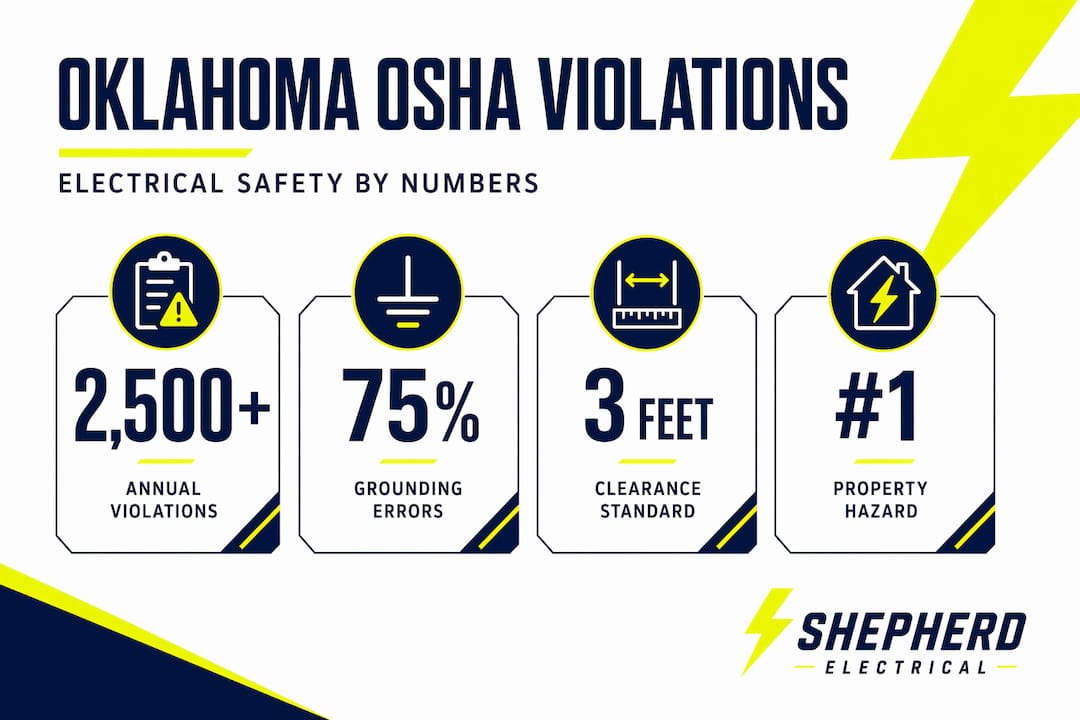
Improper grounding is particularly dangerous because the consequences are invisible until something goes wrong. A circuit with missing or faulty grounding can deliver a lethal shock through an appliance casing that looks perfectly fine from the outside. Missing or damaged equipment guards create direct exposure to energized parts. Cramped clearances around panels prevent safe access and increase the likelihood of accidental contact during routine maintenance.
| Hazard | Risk | OSHA requirement |
|---|---|---|
| Blocked panel clearance | Can’t escape or work safely | 3-foot minimum clearance |
| Missing equipment guards | Accidental contact with live parts | Guards required for 50 V and above |
| Improper grounding | Shock through appliance casings | Ground fault protection required |
| Exposed wiring | Fire and shock risk | No exposed conductors permitted |
| Overloaded circuits | Fire hazard | Properly rated conductors required |
Most common electrical violations found in Oklahoma buildings:
- Extension cords used as permanent wiring solutions
- Panels installed in closets or areas with inadequate clearance
- Missing ground fault circuit interrupter (GFCI) protection in wet locations
- Open wiring connections in junction boxes without covers
- Circuits without proper overcurrent protection
Using your inspection checklist for safety is a practical starting point for identifying these issues before an inspector or an incident does.
Arc flash risks and the role of PPE in electrical safety
Understanding arc flash is crucial to fully grasp why specialized PPE and procedures are required for electrical safety.
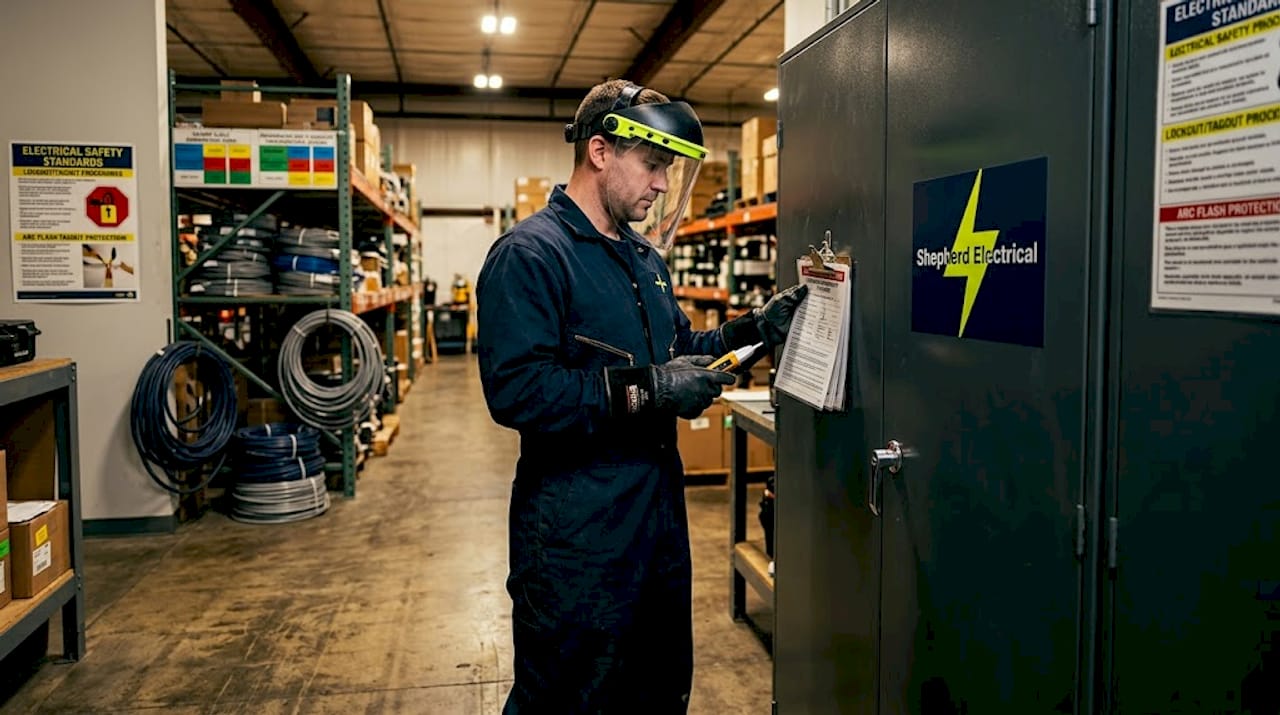
An arc flash is an explosive release of energy caused by an electrical fault. Think of it as an unintended arc of electricity traveling through air between two conductors. The resulting blast can generate temperatures up to 35,000 degrees Fahrenheit, which is hotter than the surface of the sun. It produces intense light capable of causing permanent blindness, a pressure wave strong enough to knock a person across a room, and shrapnel from vaporized metal. This is not a theoretical risk. It is a documented cause of serious workplace injury.
OSHA’s approach to controlling arc flash follows a hierarchy of controls:
- Elimination: Deenergize equipment fully before work begins whenever possible
- Engineering controls: Install arc-resistant equipment and use remote racking devices
- Administrative controls: Implement written procedures, permit systems, and LOTO programs
- PPE: Use arc-rated face shields, gloves, and flame-resistant clothing rated for the energy level of the task
Deenergizing alone does not eliminate arc flash risks. Full lockout/tagout procedures and arc-rated PPE are required even when a technician believes equipment is off. Stored energy in capacitors or back-fed circuits can still produce a flash.
“Electrical hazards cause more than 300 deaths and 4,000 injuries among U.S. workers every year, and many of those fatalities involve workers who are not electricians by trade.” — OSHA
Pro Tip: Before any contractor begins electrical work on your Oklahoma property, ask to see their written LOTO procedure for your specific equipment. If they don’t have one, that is a red flag. Familiarizing yourself with safe residential wiring practices helps you understand what responsible electrical work looks like before it starts.
Practical steps Oklahoma property owners can take to ensure OSHA compliance
With detailed knowledge on hazards and protection, here’s how to practically apply OSHA electrical safety in your property.
Compliance is not a passive outcome. It requires deliberate, recurring actions by you as the property owner. The following steps form the backbone of OSHA compliance for electrical work.
- Schedule routine electrical inspections focused on clearances, guarding, grounding, and labeling. Annual inspections catch issues before they compound.
- Verify contractor qualifications before work begins. Ask for proof of OSHA training, licensing, and insurance. A contractor familiar with OSHA guidelines for electrical work will not hesitate to share credentials.
- Maintain clear working space around all electrical panels and disconnect switches at all times. A minimum of 3 feet must remain unobstructed.
- Keep arc flash labels current. Arc flash labels must be updated every 5 years, and owners bear responsibility for ensuring their equipment is labeled and compliant.
- Document everything. Keep records of inspections, training certificates, and any repairs made to electrical systems.
Quick checklist for ongoing electrical safety:
- Confirm all panels have complete covers with no open knockout holes
- Verify GFCI protection is present in bathrooms, kitchens, garages, and outdoor areas
- Check that all electrical equipment is properly labeled with voltage ratings
- Ensure no extension cords are being used in place of permanent wiring
- Confirm all contractors working on-site have documented OSHA safety training
Pro Tip: Schedule a professional electrical safety audit every two to three years even if nothing seems wrong. Many hazardous conditions are completely invisible to untrained eyes, and catching them early is far less expensive than dealing with a citation or an incident.
Why most homeowners and businesses misunderstand OSHA electrical safety — and what really protects you
Here is a perspective on the challenges and truths many property owners overlook.
The most dangerous belief in electrical safety is not ignorance of the rules. It is partial knowledge. Property owners who know just enough to feel confident are often the ones who miss the most critical hazards. They turn off a breaker and assume the panel is safe to open. They hire a contractor who completed basic training years ago and assume that is enough. They see a circuit labeled “off” and treat it like a guarantee.
OSHA’s own research confirms the pattern. Most electrical work occurs on energized equipment without proper lockout/tagout in place, which is a widespread practice that leaves workers directly exposed to hazards that many assume have been controlled. The lock and tag are not bureaucratic formalities. They are the barrier between a safe repair and a fatality.
What makes this harder in Oklahoma specifically is that electrical safety training tends to stop at the licensed electrician level. But painters, drywall crews, landscapers, and general laborers regularly work near electrical equipment on residential and commercial sites without any training in recognizing electrical hazards. As a property owner, that is your exposure. If a subcontractor gets hurt on your property because of an electrical hazard you could have addressed, the consequences land on you.
“Electrical fatalities disproportionately affect workers who are not classified as electricians, including those in construction trades and maintenance roles.” — OSHA
The uncomfortable truth is that OSHA compliance paperwork and a clean inspection record do not automatically mean your property is safe. They mean it was safe at a specific moment in time. Electrical systems degrade, conditions change, and new work creates new hazards. Staying genuinely safe requires ongoing vigilance, not a one-time audit. Read through electrical safety blog insights to stay informed on what practical electrical safety looks like between inspections.
How Shepherd Electrical can help keep your Oklahoma property OSHA compliant and safe
For expert help applying these standards and protecting your property, Shepherd Electrical offers trusted local services.
Navigating OSHA electrical safety standards is straightforward when you work with electrical contractors in OKC who treat compliance as a baseline, not an afterthought. Shepherd Electrical serves homeowners and businesses throughout Edmond and the Oklahoma City Metro with installations, inspections, panel upgrades, GFCI protection, and safety audits that are grounded in current OSHA and NEC standards.

From verifying your working clearances to updating arc flash labels, our team brings documented training and hands-on experience to every job. Explore our full electrical services overview to see how we support safe, code-compliant electrical systems for properties of every size. When you’re ready to take the next step, choosing the right electrical contractor starts with a team that knows exactly what OSHA requires and how to meet it. Contact Shepherd Electrical today to schedule your inspection or assessment.
Frequently asked questions
What does OSHA electrical safety cover for home and business owners?
OSHA electrical safety covers safe installation, maintenance, training, and hazard prevention to protect workers and property from electrical hazards like shock, arc flash, and fire. The core standards in 29 CFR 1910 Subpart S apply to equipment operating at 50 volts or more, which includes nearly every electrical component in a home or commercial building.
Who must receive electrical safety training under OSHA?
Any employee exposed to electrical hazards, including qualified electricians, those opening panels, and general workers using cords or tools, must receive OSHA-required training. Per OSHA 29 CFR 1910.332, this applies to both skilled trade workers and those who simply work in proximity to live electrical equipment.
What is the minimum safe working space around electrical equipment according to OSHA?
OSHA requires a minimum of 3 feet of clearance in front of electrical equipment operating at 600 volts or less. OSHA CFR 1910.303(g)(1) sets this requirement to ensure workers can safely access, operate, and exit the area in an emergency.
How do arc flash hazards affect electrical safety and compliance?
Arc flash hazards can cause severe injury or death, and OSHA requires hazard assessments, lockout/tagout procedures, and arc-rated PPE to protect workers and stay compliant. Deenergizing equipment alone does not eliminate arc flash risk, making proper protective procedures non-negotiable on any work site.
How can Oklahoma property owners ensure they meet OSHA electrical safety standards?
Owners should verify contractor qualifications and training, maintain clearances around equipment, keep arc flash labels updated every five years, and schedule routine professional inspections. Per arc flash labeling requirements, the responsibility for maintaining compliant labels falls directly on the property owner, not the contractor who installed them.
Recommended
- Your complete guide to residential electrical installation
- Shepherd Electrical Blog – Shepherd Electrical
- Electrical inspection checklist: ensure safety and code compliance
- Safe Electrical Installation Guide for Edmond & OKC Homes
Need help with this at your home?
Shepherd Electrical helps Edmond and OKC metro homeowners with shop, commercial, and full-service electrical work. Free estimates are available, and workmanship is backed by a lifetime guarantee.