

TL;DR:
- Electrical load management controls household appliance power use to prevent circuit overloads and lower energy costs. Proper practices include monitoring real-time usage, staggering high-draw appliances, and using automated load controllers to avoid expensive panel upgrades. Repeated breaker trips indicate overloading, not faulty breakers; addressing loads and scheduling off-peak use improve safety and efficiency.
Electrical load management is the practice of monitoring and controlling how much power your household appliances draw at any given time, keeping total demand within your panel’s safe capacity. Without it, circuits overload, breakers trip repeatedly, and your wiring faces stress it was never designed to handle. The U.S. Department of Energy and the GreenHome Institute both recognize load management as a core strategy for reducing peak demand, improving grid stability, and cutting energy costs. For homeowners and property managers in the Edmond and OKC area, applying the best practices for electrical load management means safer systems, lower bills, and fewer expensive surprises.
1. What are the best practices for electrical load management?
The single most effective starting point is knowing what your panel can handle before adding new appliances. Your breaker panel has a rated capacity, and every device you plug in draws from that total. Staying aware of that ceiling prevents the most common residential electrical problems.
- Monitor real-time usage. Smart meters and plug-level energy monitors show you exactly which appliances draw the most power. Knowing your baseline is the first step toward controlling it.
- Stagger high-draw appliances. Running your dryer, oven, and EV charger at the same time is a recipe for a tripped breaker. Spread them out across different time windows.
- Use automated load controllers. Devices designed for EV chargers and heat pumps can throttle power automatically when household demand spikes, preventing overloads without any manual effort.
- Distribute appliances by circuit, not by room. A kitchen with a microwave, toaster, and coffee maker all on one circuit is a load problem waiting to happen. Spread high-draw devices across separate circuits.
- Schedule major loads off-peak. Running dishwashers and washing machines after 9 p.m. reduces strain during peak hours and can lower your utility bill.
- Review your panel capacity annually. Household electrical demand grows over time as you add devices. A yearly check confirms your panel still matches your actual usage.
Pro Tip: Label every breaker in your panel with the specific appliances it serves. That one step makes load distribution far easier to manage and speeds up troubleshooting when something trips.
2. How load management technology prevents costly panel upgrades
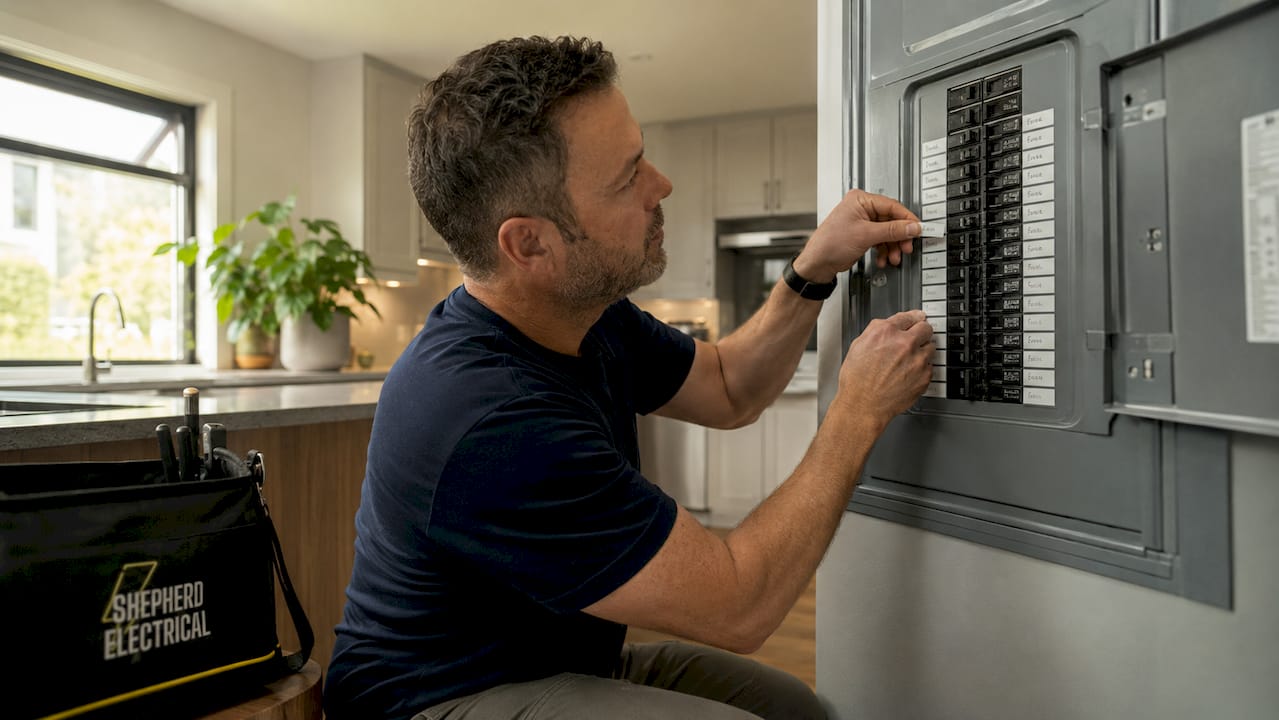
Most homeowners assume adding an EV charger or heat pump means a full panel upgrade. That assumption is often wrong. Homes with 150-amp service can support full electrification when automated load management devices are in place. That finding changes the math on what an upgrade actually costs versus what a load controller costs.
Modern load management systems watch your panel’s real-time demand and reduce power to lower-priority loads automatically. An EV charger with built-in load management, for example, will pull back its charging rate when the oven and air conditioner run simultaneously. The charger still works. The panel does not overload. No service expansion required.
The GreenHome Institute notes that automated load controllers are code-compliant and allow safe electrification within existing panel limits, making them a practical first step before committing to a full service upgrade.
The cost difference is significant. A load management controller for an EV charger typically costs a fraction of what a service upgrade from 150 amps to 200 amps runs. For property managers overseeing multiple units, that savings multiplies fast. Shepherdelectricalconstruction installs EV charger systems with integrated load management for exactly this reason.
3. Common mistakes homeowners make with electrical load management
The most widespread mistake is treating a tripped breaker as a faulty breaker. Breaker trips signal circuit overloading, not a broken breaker. Resetting it without addressing the load that caused the trip is like silencing a smoke alarm without checking for fire.
- Blaming the breaker instead of the load. A breaker that trips repeatedly is doing its job. The problem is the demand placed on that circuit, not the breaker itself.
- Ignoring warning signs. Heat near outlets, buzzing sounds, or burning smells near your panel are not minor annoyances. They are signals that your load exceeds what the wiring can safely carry.
- Stacking high-power devices on one circuit. Multiple high-draw devices on a single circuit cause nuisance trips and accelerate wiring wear. Load distribution by circuit capacity is what matters, not by physical room location.
- Jumping straight to a panel upgrade. Homeowners frequently overestimate the need for a full upgrade. Load management controls often solve the problem at a fraction of the cost.
- Skipping professional assessment. When symptoms go beyond occasional trips, a licensed electrician needs to evaluate the system. DIY resets do not identify underlying wiring problems.
Pro Tip: If a breaker trips more than twice in a week under normal usage, stop resetting it and call a licensed electrician. Repeated resets on an overloaded circuit are a fire risk.
4. Monitoring and optimization strategies that maximize load efficiency
Demand-side management, known as DSM, is the formal term for what most homeowners do informally when they shift laundry to off-peak hours. Formalizing that process with scheduling and monitoring tools produces measurable results. Appliance-level load shifting reduces daily electricity costs by 12.23% and cuts peak demand significantly. That kind of reduction comes from scheduling, not from buying new appliances.
Scheduling and forecasting
Set your dishwasher, washing machine, and water heater to run during off-peak windows. Load-shifting schedules starting at 8 a.m. balance user comfort with demand reduction across a 24-hour window. Most modern appliances have built-in delay timers that make this straightforward.
Smart home integration
Energy management systems that connect your thermostat, EV charger, and major appliances give you a single dashboard view of your household load. When one device ramps up, the system can automatically reduce another. Advanced DSM modeling achieves a 27.0% energy cost reduction and a 23.1% peak load reduction. It also increases renewable energy use by 57.5% when solar or battery storage is part of the system.
| Strategy | Primary Benefit | Best For |
|---|---|---|
| Appliance scheduling | Reduces peak demand and lowers bills | All homeowners |
| Automated load controllers | Prevents panel overload without upgrades | Homes adding EV chargers or heat pumps |
| Smart energy management systems | Full household load visibility and control | Property managers and larger homes |
| Renewable integration with load control | Maximizes solar or battery storage use | Homes with existing solar panels |
Reviewing your load schedule every six months keeps your system aligned with how your household actually uses power. Seasonal changes in Oklahoma, from summer AC peaks to winter heating loads, shift your demand profile enough to warrant a fresh look at your scheduling.
Key takeaways
Effective electrical load management keeps your panel safe, your bills lower, and your system ready for new high-power devices without requiring a full service upgrade.
| Point | Details |
|---|---|
| Stagger high-draw appliances | Never run your dryer, oven, and EV charger simultaneously to prevent circuit overloads. |
| Use automated load controllers | Controllers throttle power to specific devices automatically, protecting your panel without a service upgrade. |
| Treat breaker trips as warnings | Repeated trips signal overloading, not a faulty breaker. Address the load, not just the symptom. |
| Schedule loads off-peak | Shifting laundry and dishwasher use to off-peak hours cuts costs and reduces peak strain. |
| Get a professional assessment | A licensed electrician can identify whether load management or a panel upgrade is the right solution. |
What I’ve learned from years of watching homeowners manage their electrical loads
Most homeowners I talk to in Edmond and the OKC area come to me after they’ve already reset the same breaker a dozen times. By that point, they’ve been living with a problem that a simple load audit would have caught months earlier. The fix is rarely as expensive as they feared.
The behavioral changes cost nothing. Staggering your appliances, scheduling your laundry, and knowing which circuit serves which outlet are habits that pay off immediately. They also make every other improvement you add to your home more effective.
Where I’ve seen the biggest shift is in how load management technology has changed the panel upgrade conversation. Five years ago, adding an EV charger almost always meant a service upgrade. Now, with a properly installed load management controller, most 150-amp homes handle it without touching the panel. That’s a real change in what’s possible, and most homeowners don’t know it yet.
My honest recommendation: start with a home electrical efficiency review before spending money on hardware. Understand your current load, identify where the peaks are, and then decide what technology actually solves your problem. Load management is not a one-time fix. It’s an ongoing process that gets easier as you understand your system better.
— Brad
Shepherdelectricalconstruction can handle your load management needs
Managing your home’s electrical load is easier with a professional who knows your panel, your circuits, and your household’s actual demand.
Shepherdelectricalconstruction serves homeowners and property managers across Edmond, North OKC, NW OKC, Deer Creek, Nichols Hills, and nearby areas. The team installs dedicated circuits and home wiring designed to distribute your loads safely, and can assess whether a load management controller or a panel upgrade is the right call for your situation. No guesswork, no overselling. Call or text (405) 406-1026, or book directly online to schedule your assessment.
FAQ
What is electrical load management for homeowners?
Electrical load management is the practice of monitoring and controlling how much power your appliances draw to keep total demand within your panel’s safe capacity. It prevents overloads, reduces energy costs, and extends the life of your wiring.
Why does my breaker keep tripping?
A repeatedly tripping breaker almost always signals that the circuit is overloaded, not that the breaker is broken. Stagger your high-draw appliances and avoid running multiple large devices on the same circuit at the same time.
Can I add an EV charger without upgrading my panel?
Yes, in many cases. Homes with 150-amp service can support EV chargers when an automated load management controller is installed. The controller reduces charging speed during household demand peaks, keeping total draw within safe limits.
What is demand-side management (DSM)?
DSM is a formal approach to reducing peak electrical demand by scheduling and shifting appliance use to off-peak hours. Applied consistently, it reduces daily electricity costs and lowers the strain on your home’s circuits and the broader grid.
How often should I review my home’s electrical load?
A load review every six months is a practical standard, especially after adding new appliances or before seasonal demand shifts. A licensed electrician can perform a full circuit-level assessment when your usage patterns change significantly.
Recommended
- What Is Electrical Load? A Guide for Homeowners
- Maximize Home Electrical Efficiency: Tips for Edmond & OKC
- Home electrical systems: your guide to safety and efficiency
- Top electrical maintenance tips for Edmond & OKC homes
Need help with this at your home?
Shepherd Electrical helps Edmond and OKC metro homeowners with residential electrical service, repairs, upgrades, panels, EV chargers, solar, and backup power. Free estimates are available, and workmanship is backed by a lifetime guarantee.