

TL;DR:
- Business outage preparedness involves plans, equipment, and trained responses to maintain operations during power failures. Using tiered backup power systems and regular drills helps businesses recover quickly and minimize revenue loss. Proper surge protection and defined operational roles are essential for safeguarding equipment and ensuring effective response.
Business power outage preparedness is defined as the set of plans, equipment, and trained responses that keep your operations running when the grid fails. Power outages rank among the most frequent and impactful risks for businesses of every size, demanding proactive action rather than reactive scrambling. A solid power outage business plan covers backup power, role assignments, equipment protection, and practiced recovery steps. IRS and CFIB guidance requires annual plan reviews and emergency drills at least twice per year. Businesses that follow these standards recover faster and lose far less revenue than those that improvise.
1. What are the essential backup power solutions for businesses?
Tiered backup power is the most effective approach to business continuity during outages. The first tier covers Uninterruptible Power Supplies (UPS), which provide immediate failover for small critical loads. A UPS keeps your internet router, point-of-sale terminal, and core workstation running for minutes to hours while you safely shut down or switch to a generator.
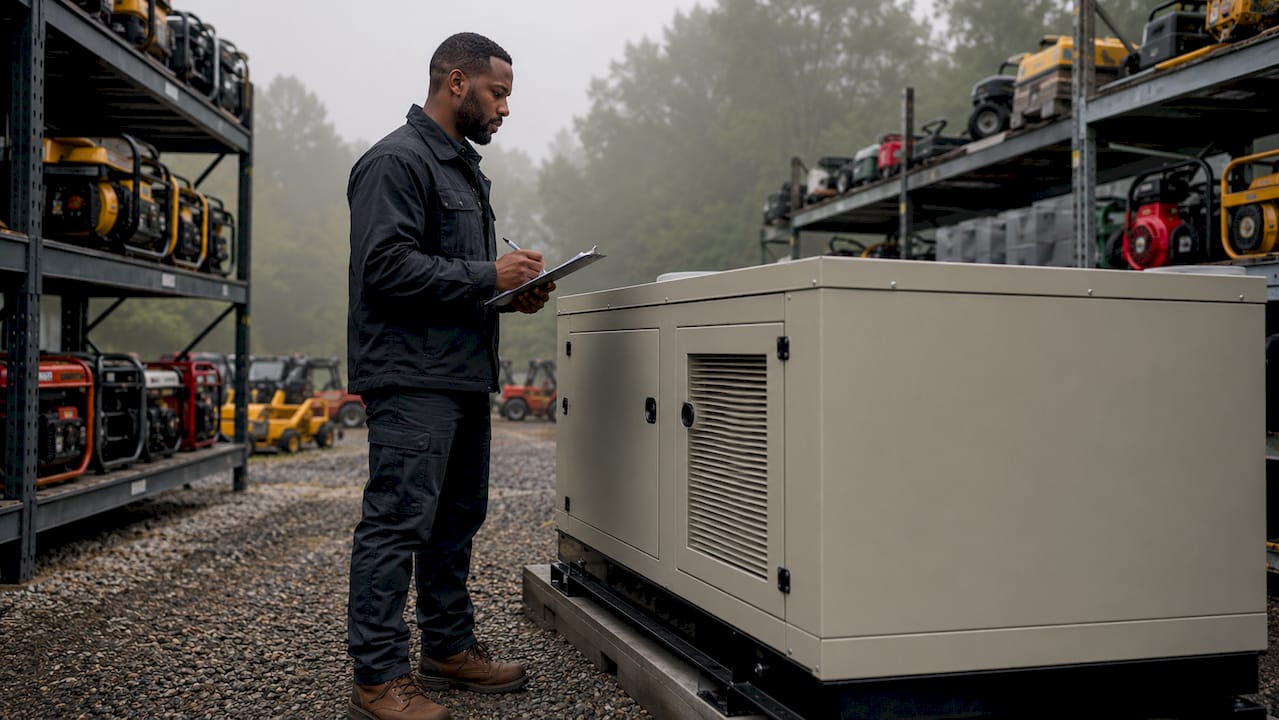
The second tier covers generators and commercial battery systems for larger loads. Backup generators and batteries sustain refrigeration, HVAC, and lighting across your facility. Choosing the right capacity requires knowing your Recovery Time Objective (RTO), which classifies each system by how quickly it must return to operation. RTO classifications focus your backup investment on critical functions and prevent overspending on non-essential loads.
| Backup Type | Best For | Key Advantage | Limitation |
|---|---|---|---|
| UPS | Internet, POS, workstations | Instant failover, no startup delay | Short runtime (minutes to hours) |
| Portable generator | Mid-size loads, refrigeration | Affordable, flexible | Requires fuel, manual startup |
| Standby generator | Full facility power | Automatic, long runtime | Higher installation cost |
| Commercial battery | Critical circuits, quiet spaces | Silent, no emissions | Higher upfront cost |
Pro Tip: Scale your backup power capacity to your RTO list, not your full electrical load. Powering everything is expensive. Powering only what keeps you open is practical.
2. How can businesses protect equipment from power surges and electrical damage?
Surge protection prevents permanent electronics damage at the moment power is restored, which is when voltage spikes are most dangerous. A professional-grade whole-building surge protector, installed at your main panel, stops those spikes before they reach your servers, registers, or medical equipment. Point-of-use surge strips add a second layer for individual workstations.
Manual protocols matter just as much as hardware. Train staff to disconnect non-essential equipment before an extended outage and to reconnect devices in a controlled order after power returns. Periodic electrical system inspections catch aging wiring or undersized panels before they become failure points during an outage.
Best practices for equipment protection:
- Install a whole-building surge protector at the main service panel
- Add point-of-use surge strips on all workstations and registers
- Unplug non-essential equipment when an outage extends beyond 15 minutes
- Reconnect devices one at a time after power is restored, starting with the lowest-draw items
- Schedule an electrical inspection at least once per year with a licensed contractor
- Replace any surge protector that has absorbed a known spike, as its protection is depleted
3. What roles and operational steps should a business assign during an outage?
Clear crisis leadership roles accelerate decisions and prevent the confusion that costs businesses the most time and money. Assign one person as the crisis leader and a second as the spokesperson for customer and vendor communication. Every other staff member needs a defined task before an outage ever happens.
Operational steps should follow a fixed sequence. The crisis leader records the outage start time immediately. Staff then check for safety hazards, shut down heat-producing equipment first, and confirm that backup power is running correctly. The spokesperson updates customers through posted signage and pre-written social media messages.
Staff responsibilities during an outage:
- Crisis leader: records start time, activates backup power, contacts utility provider
- Safety officer: checks for smoke, tripped breakers, or overheating equipment
- Customer spokesperson: posts signage, sends pre-written updates, answers incoming calls
- IT lead: verifies UPS status, saves open files, and initiates controlled server shutdown if needed
- Operations staff: secures cash, switches to offline POS, and assists customers calmly
Pro Tip: Keep a manual fallback kit at the front desk. It should include a printed customer list, paper order forms, a battery-powered phone charger, and a roll of cash for making change. That kit pays for itself the first time your card reader goes dark.
4. How to plan and practice effective shutdown and restart drills?
Most businesses neglect recovery drills, and chaotic restarts cause secondary problems including data corruption and surge damage. A written restart sequence, covering every circuit and device in order, is the single most effective tool for a clean recovery. Without it, staff plug in equipment randomly and create the exact voltage conflicts the outage itself never caused.
Run drills at least twice per year, as IRS disaster preparedness guidance recommends. Quarterly testing before high-risk weather seasons adds another layer of confidence, especially in Oklahoma where spring storms and summer heat events are predictable.
Drill checklist elements:
- Announce the drill and assign roles before starting
- Simulate outage by cutting power to a non-critical circuit
- Activate UPS and confirm runtime on critical devices
- Execute the written shutdown sequence in order
- Start the generator or battery system and verify load transfer
- Run through the restart sequence, reconnecting circuits one at a time
- Document any failures, delays, or confusion for plan updates
- Review the drill with all staff within 24 hours
5. What additional preparations improve business continuity during outages?
A manual fallback kit is the most underrated tool in any power outage business plan. A well-stocked kit prevents a full-day revenue loss by keeping limited operations running without electricity. Test your offline POS mode before you need it. Keep enough cash and coin on hand to process transactions for at least one full business day.
Customer communication is equally critical. Prepare update messages for your website, Google Business Profile, and social media accounts in advance. A mobile hotspot gives you internet access when your wired connection fails. For businesses in areas prone to severe weather, like Edmond and North OKC, emergency preparedness for businesses also means monitoring local utility alerts and having a contact at your power provider.
Continuity practices to put in place now:
- Stock the manual fallback kit with paper receipts, appointment lists, and offline payment forms
- Test offline POS functionality monthly
- Keep a minimum cash reserve in a secure lockbox on-site
- Pre-write customer update messages and save them as drafts
- Set up a mobile hotspot as a backup internet source
- Post the utility provider’s outage reporting number in the break room
Key takeaways
A written, practiced power outage business plan is the single most effective way to protect revenue, equipment, and staff during an electrical interruption.
| Point | Details |
|---|---|
| Use tiered backup power | Pair a UPS for instant failover with a generator or battery for sustained operations. |
| Prioritize by RTO | Classify systems by recovery urgency to focus backup investment where it counts. |
| Assign crisis roles | Designate a leader, spokesperson, and safety officer before an outage occurs. |
| Practice restart drills | Run written shutdown and restart sequences at least twice per year. |
| Install surge protection | A whole-building surge protector at the main panel prevents the most common post-outage equipment damage. |
What I’ve learned after years of watching businesses get this wrong
Most business owners spend money on backup generators and then never test them. That is the pattern I see repeatedly. The generator sits in a corner, the transfer switch has never been exercised, and the first real outage reveals that the unit needs a fuel line cleared or a battery replaced. The hardware is only as good as the habit of testing it.
The second overlooked factor is the human side. A business with a $20,000 generator and no trained staff still loses hours to confusion when the lights go out. The businesses that recover fastest are the ones where every employee knows their job before the outage starts. That comes from drills, not from reading a binder once.
For business owners in Edmond and North OKC, the local electrical infrastructure faces real stress during summer heat events and spring storm season. Getting a licensed electrician to inspect your panel, install proper surge protection, and wire your generator correctly is not optional. It is the foundation everything else sits on.
— Brad
Shepherdelectricalconstruction backs your business when the power goes out
Shepherdelectricalconstruction installs backup generators, whole-building surge protection, and generator interlock wiring for businesses across Edmond and the North OKC metro. Every installation follows NEC and NFPA standards, and every system gets tested before the crew leaves your property.

Browse completed electrical projects to see the range of backup power and surge protection work done for local clients. When you are ready to build a system that actually works under pressure, call or text (405) 406-1026 or book online to schedule a consultation.
FAQ
What is the first step in a power outage business plan?
Assign a crisis leader and document a written shutdown and restart sequence for every circuit and device. Without those two elements, every other preparation loses most of its value.
How often should businesses test their backup generators?
Quarterly testing before high-risk weather seasons is the recommended standard. At minimum, run a full load test twice per year as part of your disaster drill.
What does a UPS do that a generator cannot?
A UPS provides instant power with zero startup delay, protecting devices from the gap between outage and generator startup. Generators typically take 10–30 seconds to reach full output, which is long enough to crash an unprotected server.
Why is surge protection critical after an outage, not just during one?
The moment utility power is restored, voltage spikes travel through your circuits and damage electronics. A whole-building surge protector at the main panel stops those spikes before they reach your equipment.
How do I know which systems to prioritize for backup power?
Use Recovery Time Objectives to rank each system by how quickly it must return to operation. Systems with an RTO of zero, such as refrigeration in a restaurant or a POS terminal in retail, get backup power first.
Recommended
- What Is Electrical Preventive Maintenance for Homeowners
- Backup Power Generator for Home – Solutions – Shepherd Electrical
- Commercial Electrical Maintenance Guide for Property Managers
- Top electrical maintenance tips for Edmond & OKC homes
Need help with this at your home?
Shepherd Electrical helps Edmond and OKC metro homeowners with shop, commercial, and full-service electrical work. Free estimates are available, and workmanship is backed by a lifetime guarantee.